Offered by Jan Muller
REQUEST INFORMATION

Jheronimus Sweerts I (Amsterdam, 1603 – Amsterdam, 1636) was a flower painter of the early Golden Age. He painted mainly flower still lifes and landscapes.
He was the son of Emanuel Sweerts, a nurseryman and botanist who published a florilegium in 1612, a richly illustrated book of flowers. Sweerts learned to draw from his father. He became a pupil of Ambrosius Bosschaert the Elder and, after Bosschaert’s death in 1621, continued to work with Balthasar van der Ast. In 1627 he married Maria, Bosschaert’s daughter. His son Hieronymus Sweerts (1629-1696) became an art dealer and print publisher.
Very few works by Sweerts are known on the international market. The only signed painting known by him, a Still Life with a Flower Basket and Parrot of 1626, is in the Kunsthalle Bremen.
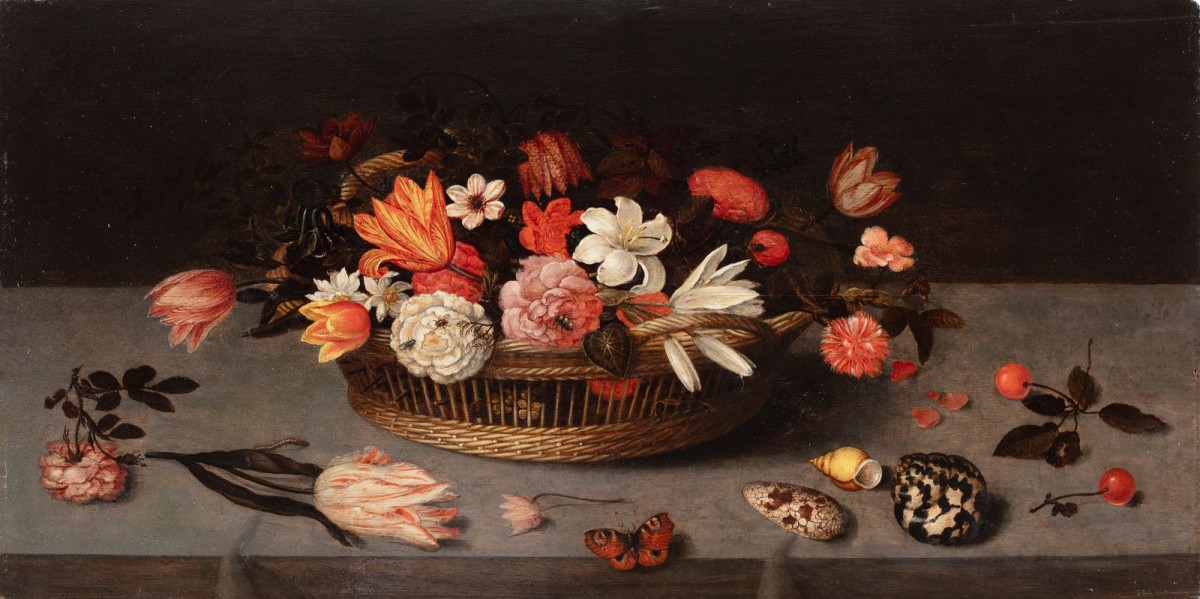
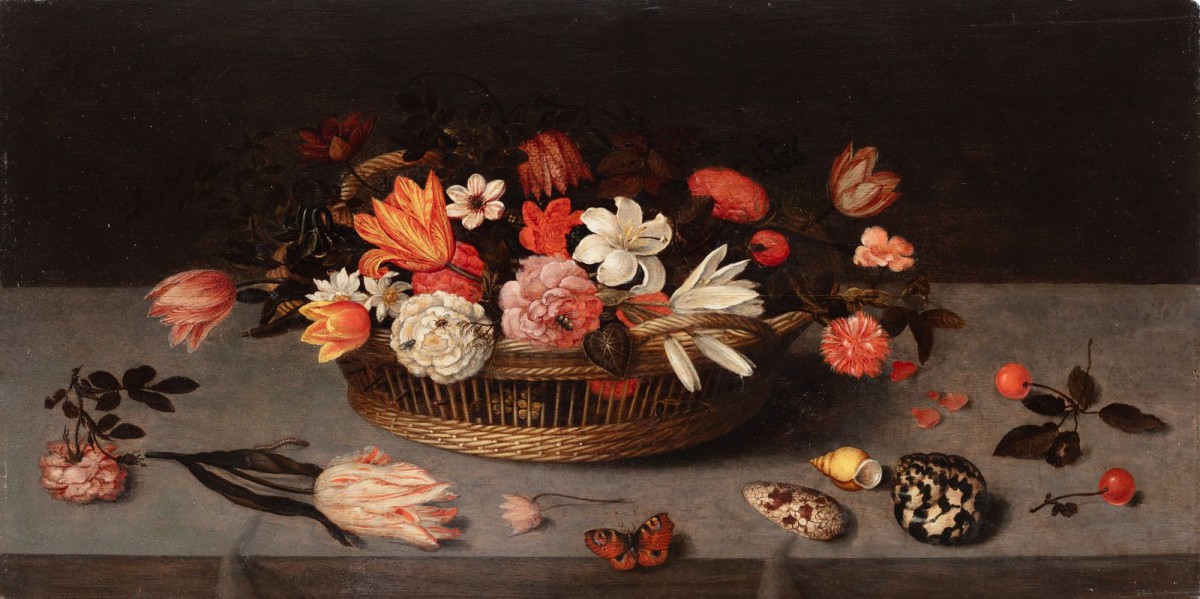
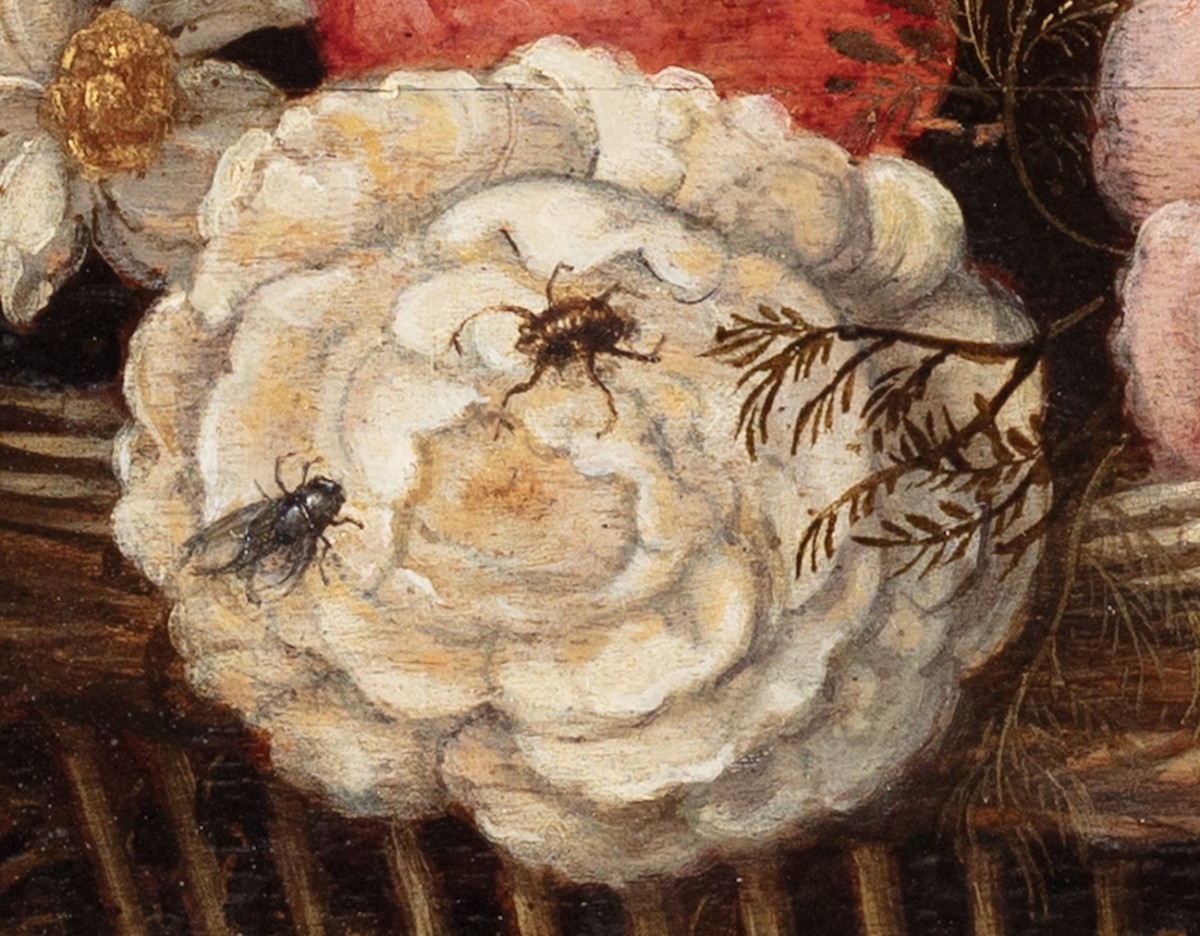
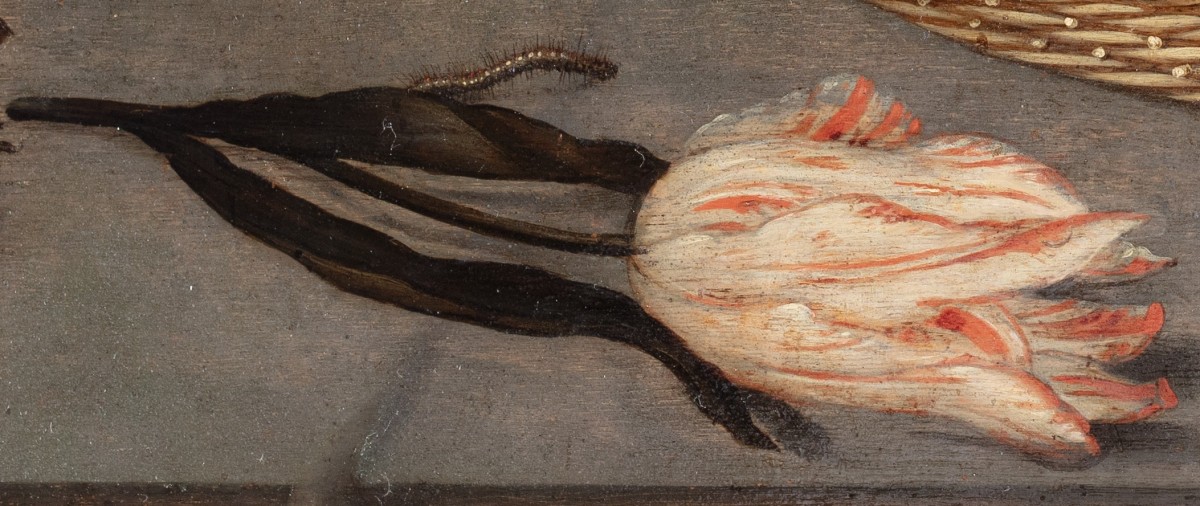
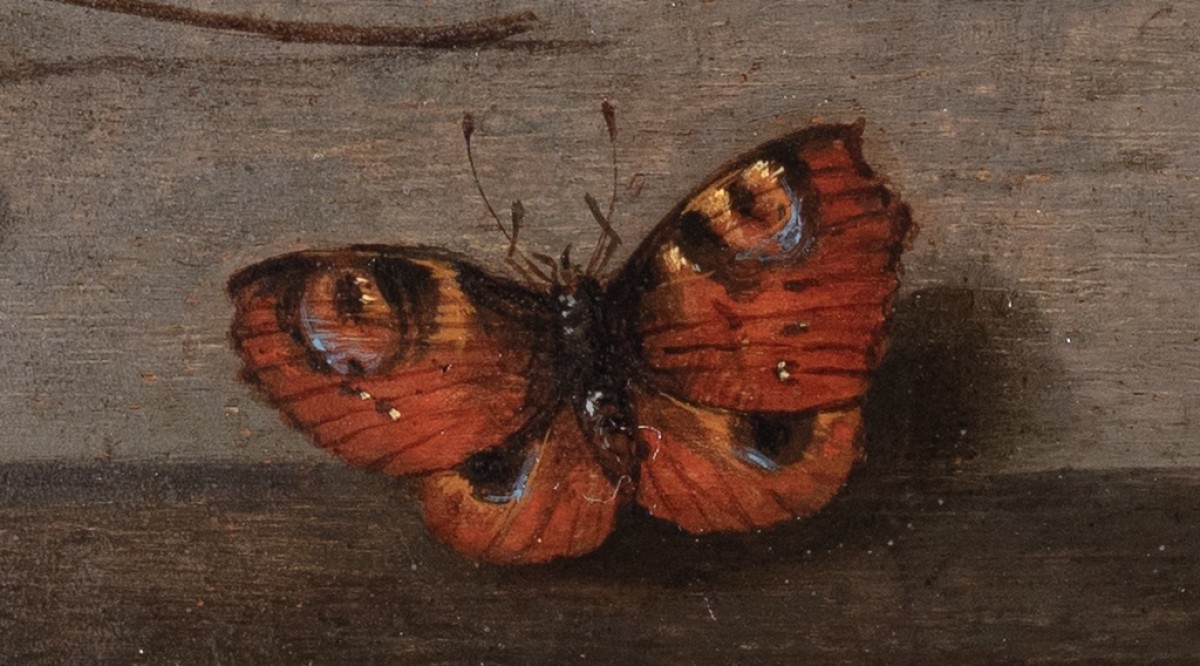
We see a wicker basket filled with flowers, mostly in red and orange tones, complemented by a few white blooms. The tulips and roses are especially recognisable. The basket stands on a stone tabletop. Around it, a few flowers from the bouquet have fallen, and two cherries can also be seen. To the right of the basket lie three shells of different shapes and colours. There is also a sign of life: a butterfly at the bottom centre, and small insects around the flowers, such as a fly and a caterpillar.
The work shows strong similarities to another work by Sweerts I in the RKD database. The way the tulips are rendered, the texture of the wicker basket, the butterflies and the elongated shell correspond closely, and both works rest on a stone table.
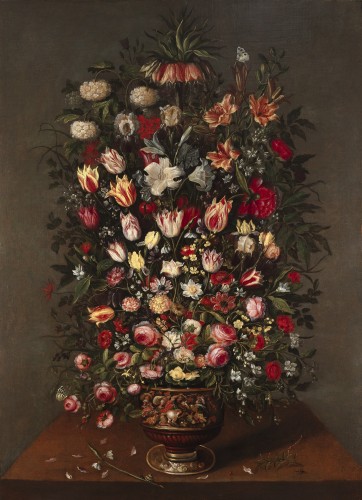
The flower still life emerged shortly before 1600 in Dutch painting, under the influence of the growing interest in exotic flowers and plants. The Fleming Jan Brueghel the Elder was the first artist in the Low Countries to master it, and Ambrosius Bosschaert the Elder was the first to devote himself exclusively to flower still lifes. The bouquets often combined flowers from different countries and even different continents, which in reality never bloomed at the same time. For wealthy collectors, a flower piece formed part of a private world that included rare garden plants, which sometimes cost more than the paintings of them.
Still-life motifs already existed earlier in manuscripts and in fifteenth- and sixteenth-century paintings, such as Robert Campin’s Annunciation Triptych and Petrus Christus’s Goldsmith in His Shop. Many of these elements referred to qualities of the Virgin or another religious figure: the lily, for example, stood for purity. As an independent genre, the still life only flourished in the Low Countries in the early seventeenth century.
The popularity of still lifes in the Northern and Southern Netherlands reflects the growing urbanisation of Dutch and Flemish society. This placed emphasis on the home and personal possessions, trade, education and all aspects of daily life. By 1700 the styles of the Northern and Southern Netherlands and of the German and French regions became less and less distinct from one another. Dutch painters worked for foreign princes, and the market spread across Europe.
Oil on panel
Dimensions: 42 x 80 cm, 64 x 102 cm (framed)
Delevery information :
After reception of payment we can box and ship our items all over the world. Estimates of this service can be provided.