Offered by Franck Baptiste Paris
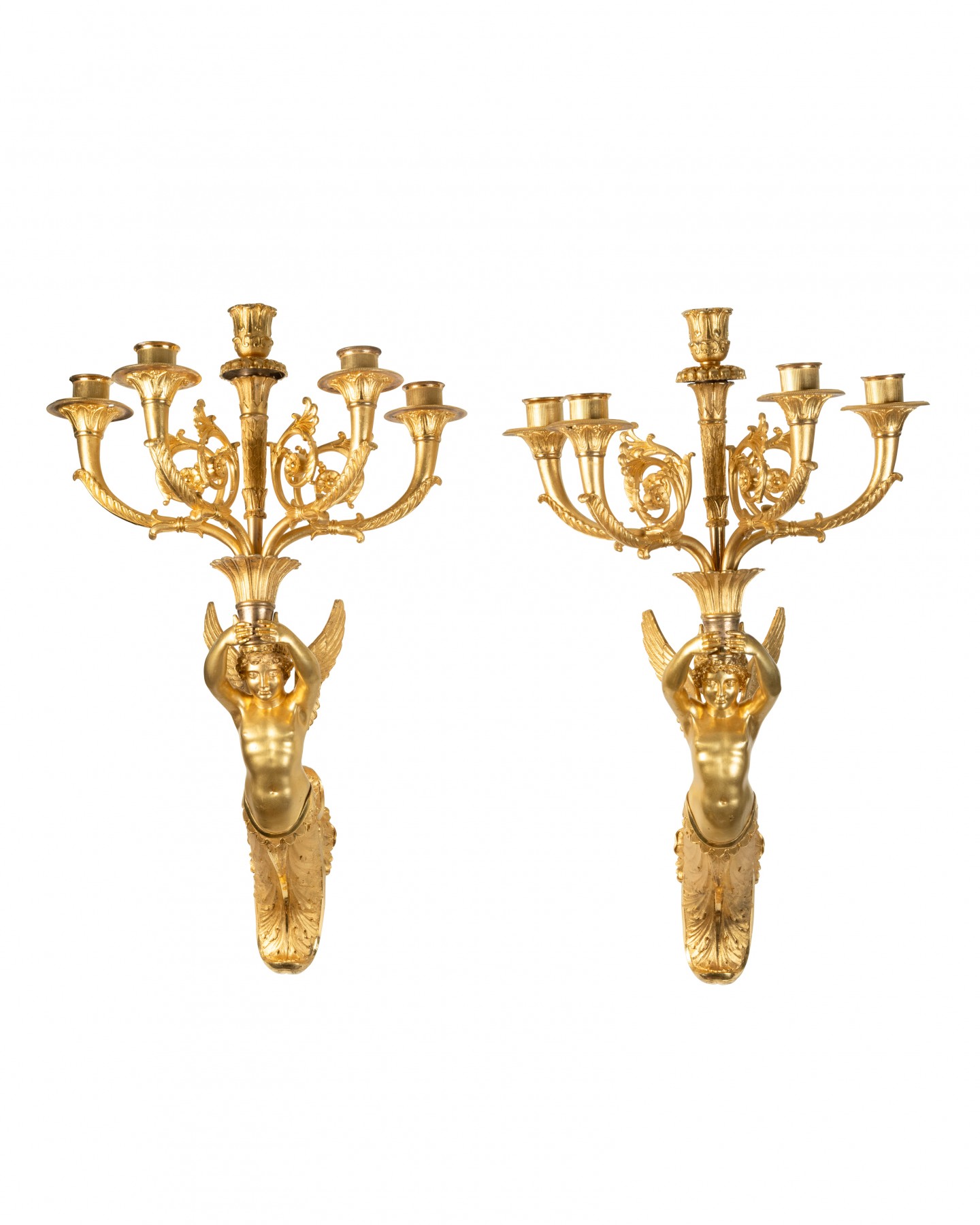
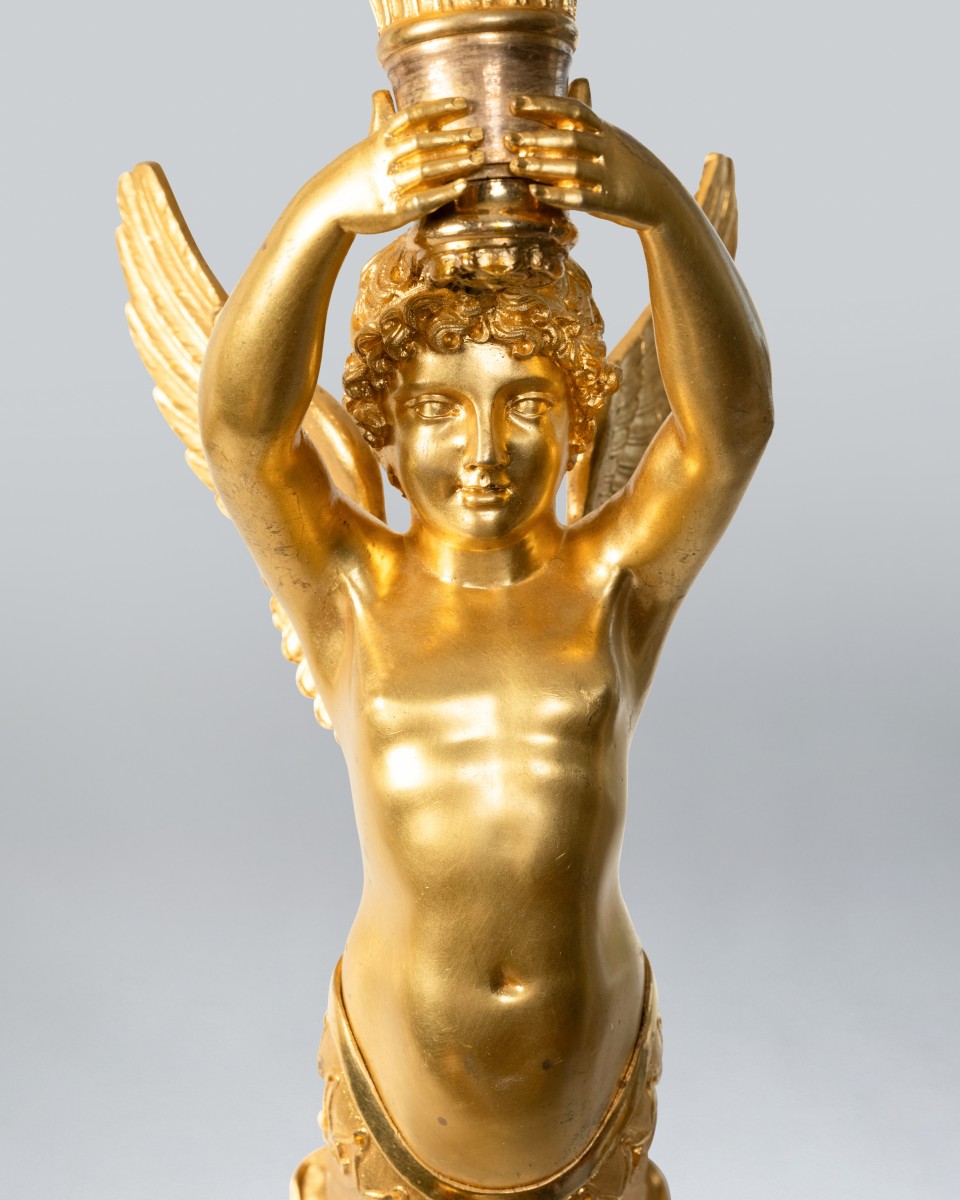
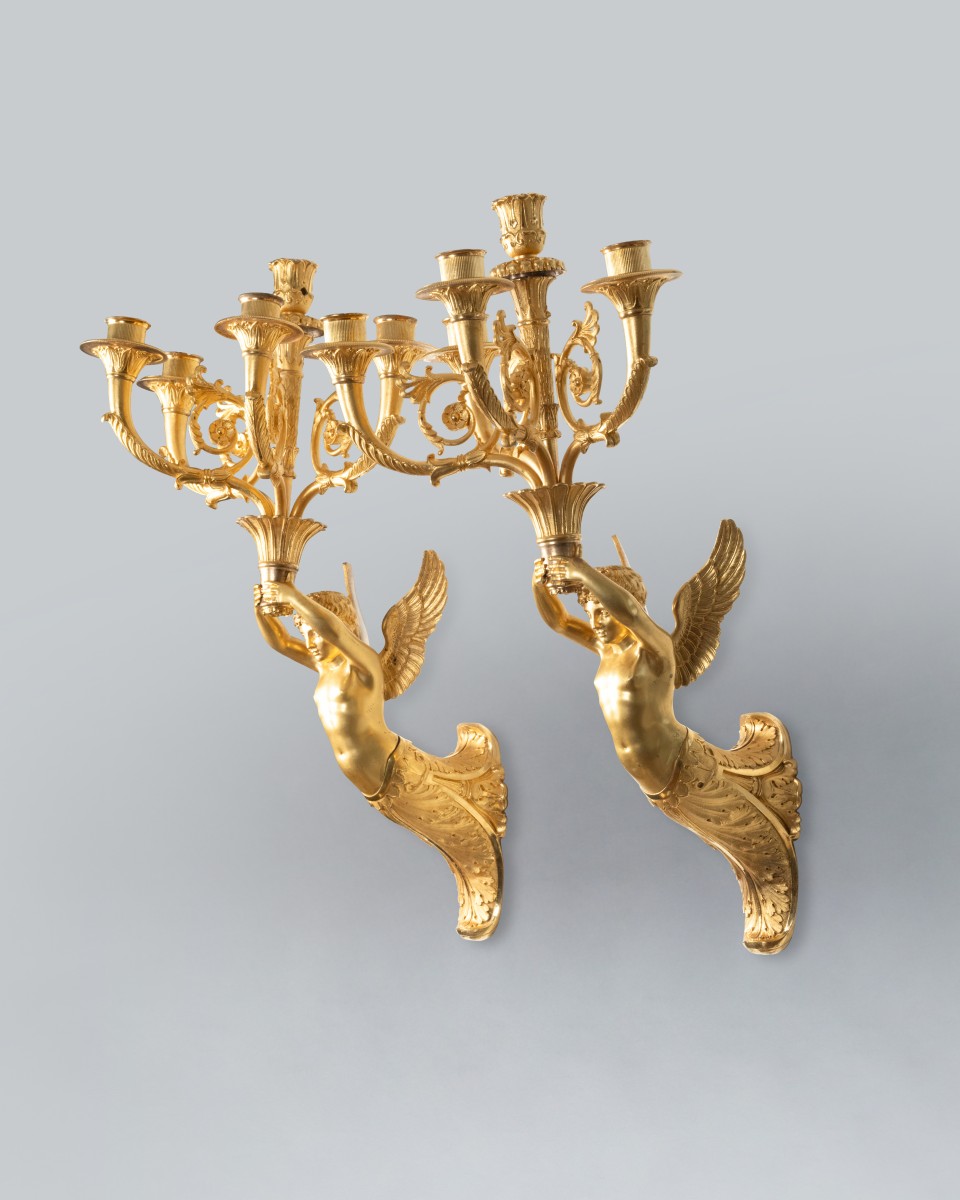
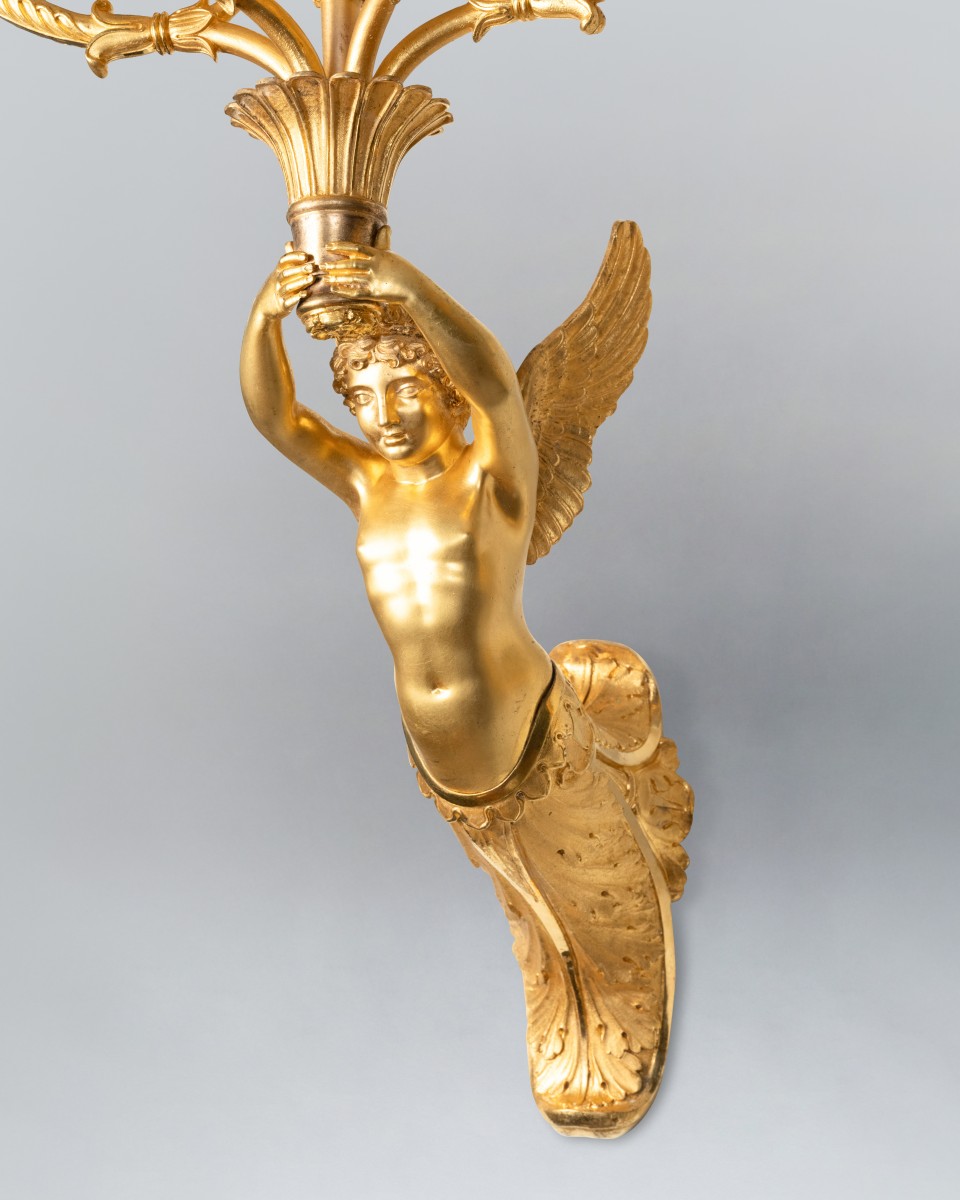
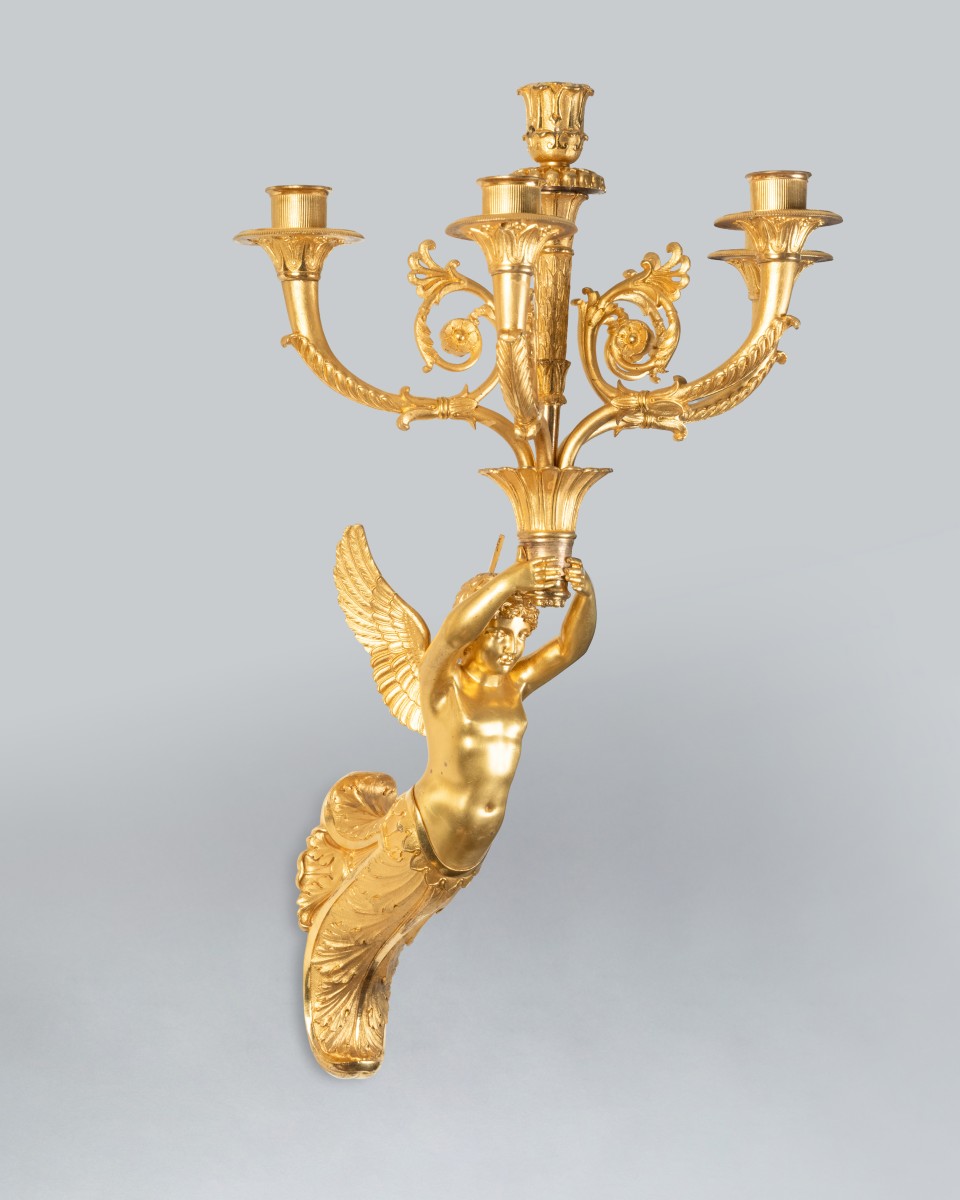

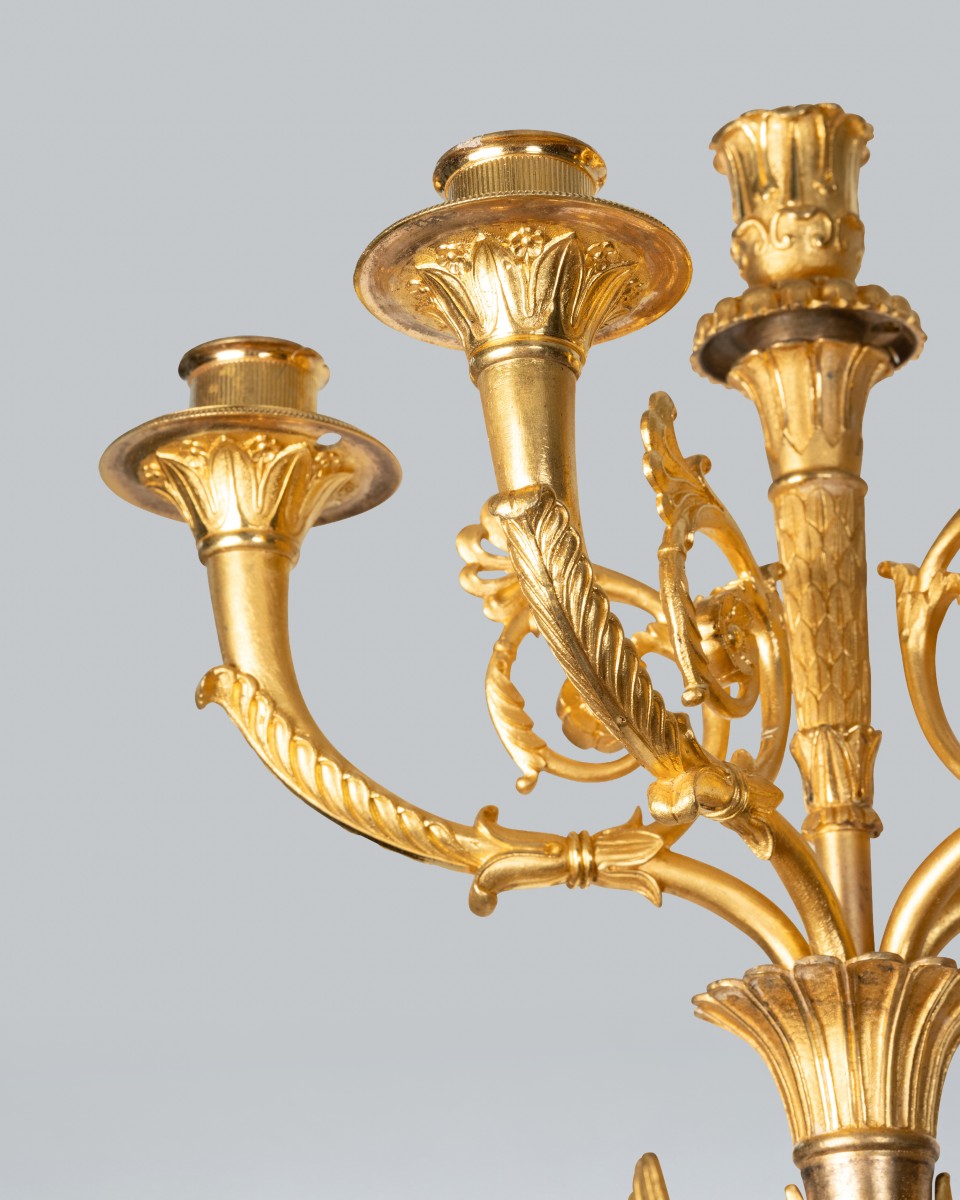
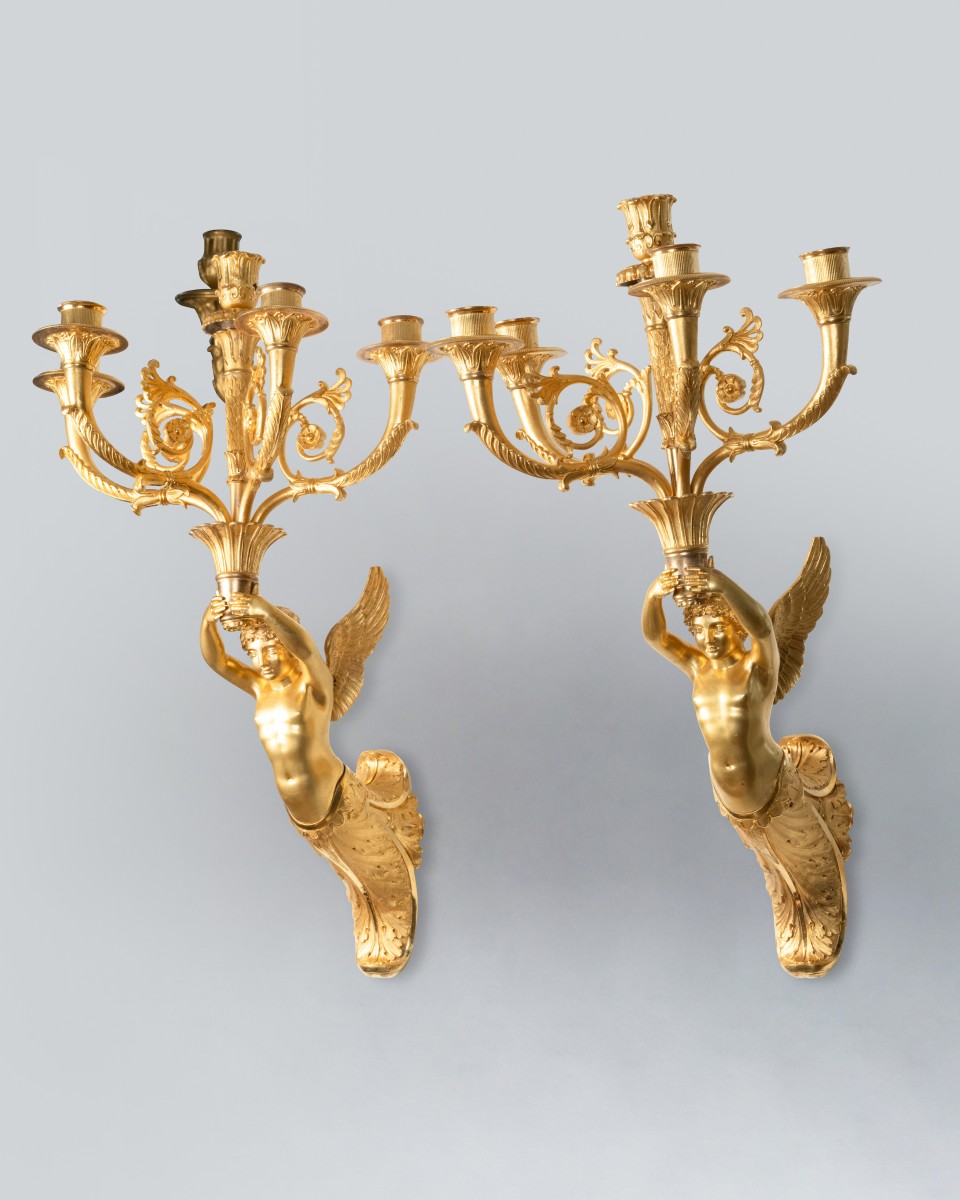
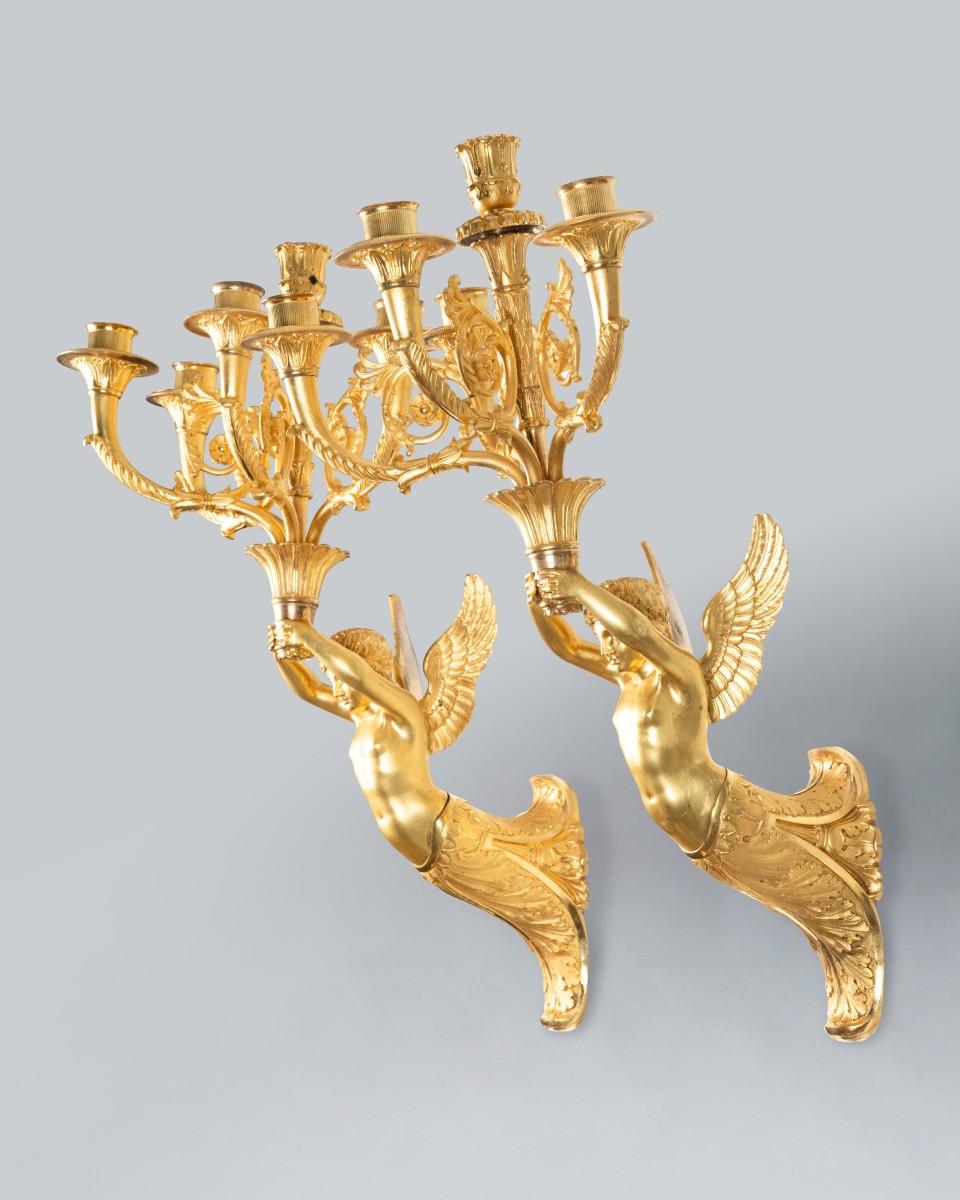
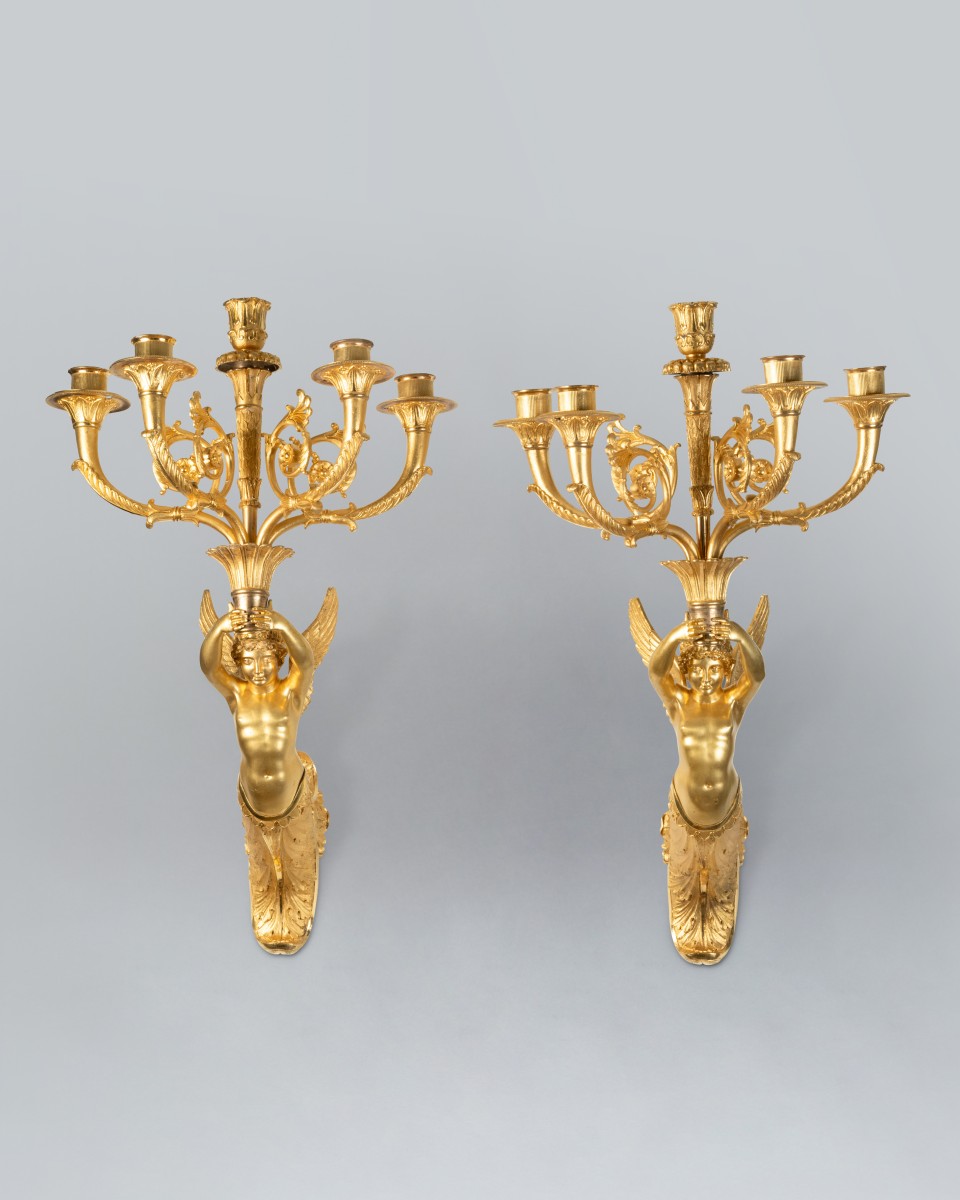
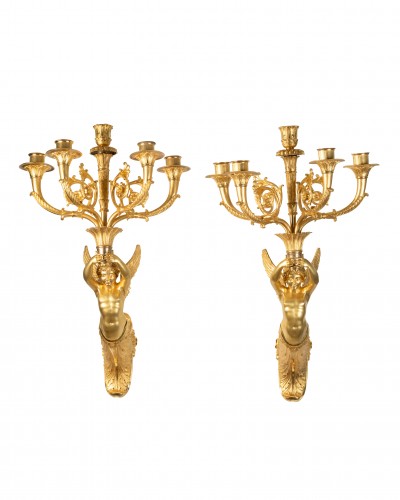
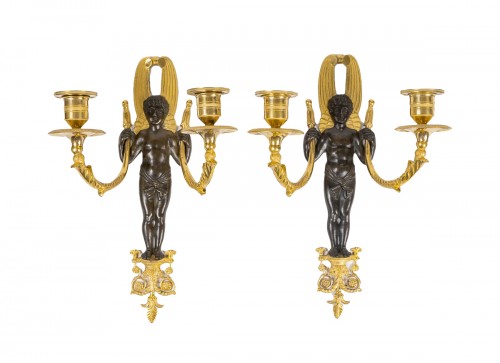
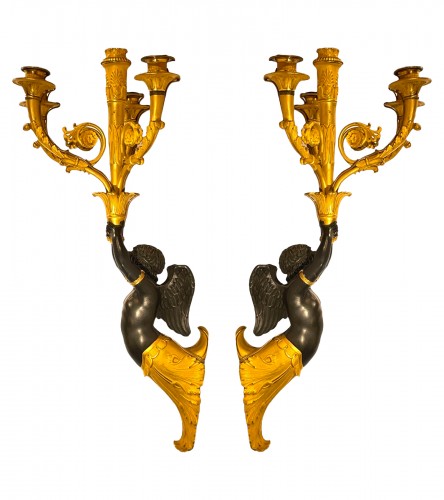
A rare pair of large wall lights in finely chased and gilt bronze. Known as the "children" model, they depict chubby putti whose torsos terminate in acanthus foliage. Above their heads, two outstretched arms support a finial from which emerge a central torch—decorated with a scale pattern—and four light branches accented with acanthus scrolls and palmette-adorned volutes.
The undersides of the drip pans are finely chased with small florets and lotus flowers.
Original gilding featuring a dual finish of matte and burnished gold; exceptional quality of chasing.
Excellent state of preservation.
Empire-period work attributable to the bronzier André-Antoine Ravrio, circa 1814.
Dimensions:
Height: 50 cm; Width: 33 cm; Depth: 32 cm
Literature:
Marie-France Dupuy-Baylet, *L'Heure, le Feu, la Lumière: Les Bronzes du Mobilier national 1800-1870*, Dijon, 2010, pp. 72–73.
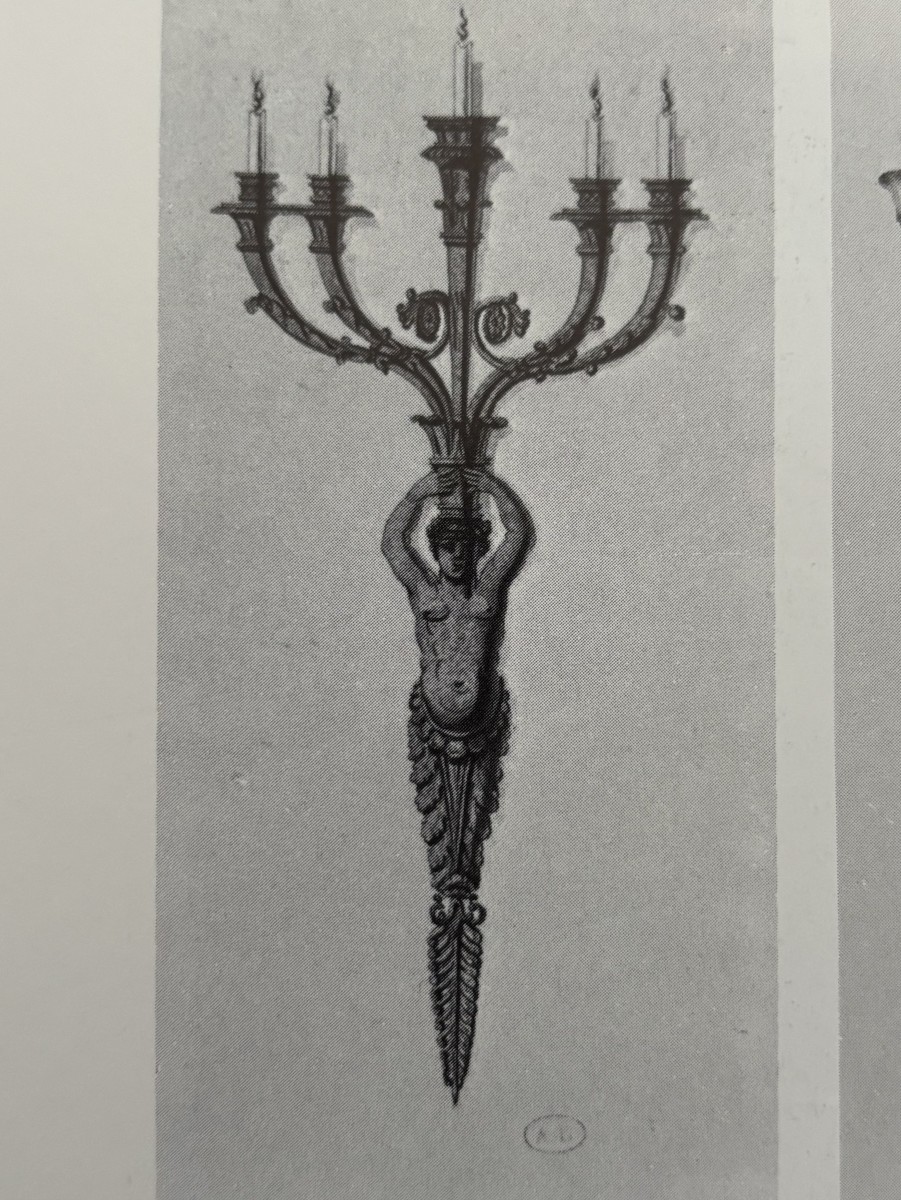
Anne Dion-Tenenbaum, *Les Bronzes d'ameublement du Louvre*, Dijon, 2004, p. 272, no. 135. ?Jean Pierre Samoyault, *Pendules et bronzes d’ameublement entrés sous le Premier Empire*, Musée national du château de Fontainebleau. ?Hans Ottomeyer & Proschel, *Vergoldete Bronzen*, Vol. I, p. 356. ? ?Similar models in museum collections: ? ?-Musée du Louvre ?-Musée national du château de Fontainebleau ?-Musée du Château de Versailles (Trianon) ?-A pair of wall lights signed Chiboust, featuring a variation in the bouquet design, was sold at public auction (Hubert de Givenchy collection, Christie’s Paris, September 14, 2021, Lot 1; €35,000).? ? ?André Antoine Ravrio (1759–1814) was born in Paris in 1759. ??He was a renowned maker of artistic bronzes, becoming a master founder in Paris in 1777. ?He set up his own business in 1790 and ran a major establishment during the Empire. Ravrio supplied furnishing bronzes to the imperial palaces and to a prestigious clientele, including Prince Murat, Louis Bonaparte, and Hortense de Beauharnais.?Gifted with literary talent, he wrote numerous poems and several vaudevilles. He was a member of many literary and charitable societies. He established a prize of 3,000 francs to encourage the discovery of a preventive measure against the dangers of using mercury in the metal-gilding profession. Antoine Ravrio died in Paris in 1814. He is buried alongside his adopted son at Père Lachaise Cemetery. Our assessment: This model of wall light—featuring a winged child terminating in a bundle of acanthus leaves and lifting a cluster of lights with outstretched arms—enjoyed great success and was frequently commissioned by the Imperial *Garde-Meuble* (Furniture Repository). Many bronzemakers, such as André Ravrio, Claude Galle, and Pierre-Philippe Thomire, supplied this type of wall light between 1808 and 1813, with variations in the design of the light clusters. The first delivery was made by Thomire-Duterme & Cie: a pair for the Emperor’s bedroom at the Palace of Fontainebleau and three pairs for the Empress’s Grand Salon on the ground floor. An invoice dated November 18, 1809, describes the item for the bedroom as "a pair of wall lights representing a child terminating in ornamental foliage, holding above his head a finial from which emerge five branches with leaves and scrolling ornaments; the entire assembly—including the figures of the children—is made of chased bronze with a matte gilt finish." The description is identical for the three pairs delivered for the salon (National Archives, reference O2 515). The following year, in 1809, the *Garde-Meuble* commissioned a pair from Claude Galle for the Empress’s Small Salon at Trianon, and four smaller pairs from André-Antoine Ravrio. The two wall lights presented here are smaller versions that correspond perfectly to those supplied by Ravrio—both in terms of size and the design of the arms, which feature acanthus scrolls rather than the hunting-horn motif. Descriptions from the *Garde-Meuble* and a drawing by Ravrio—held at the Musée des Arts Décoratifs in Paris (Album Maciet 93, drawing CD 3767) and published on page 356 of Hans Ottomeyer and Peter Pröschel’s *Vergoldete Bronzen*—enable us to attribute these four light arms to him. Because the Imperial couple chose this model for the most important and intimate rooms of their palaces, it proved so successful that numerous further Imperial commissions followed up until 1813. In addition to these official commissions, there were also significant private orders from the Imperial elite.