Offered by Gregory Redding
REQUEST INFORMATION
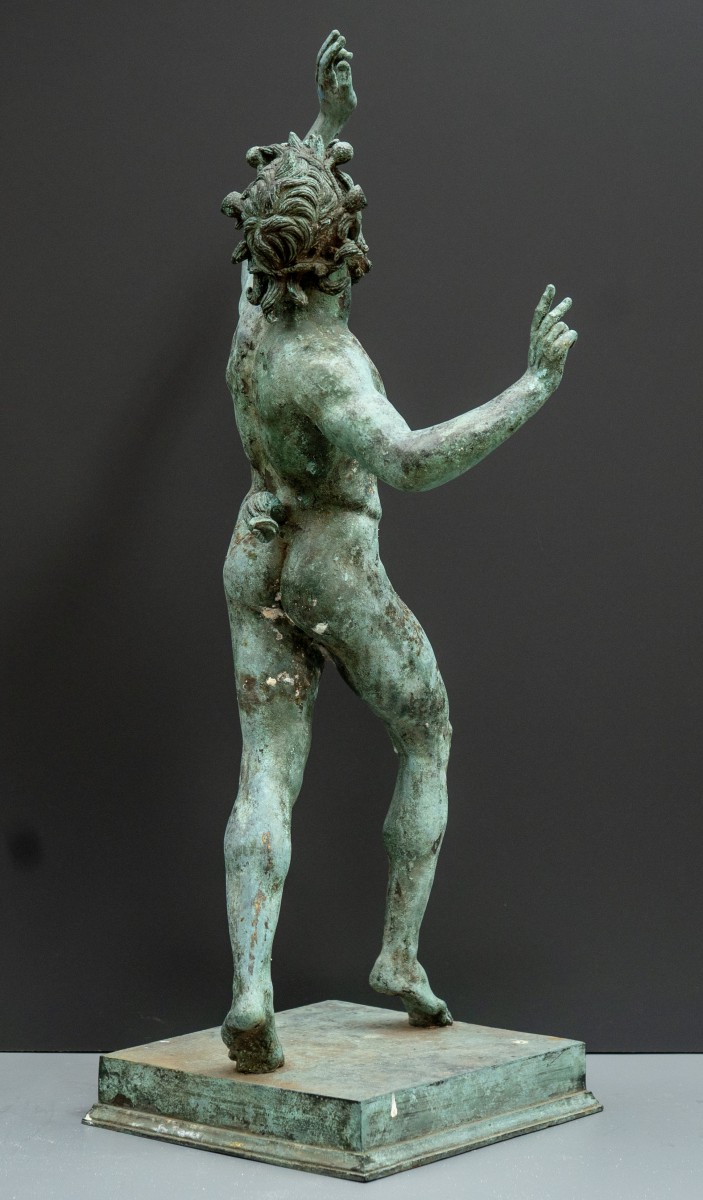

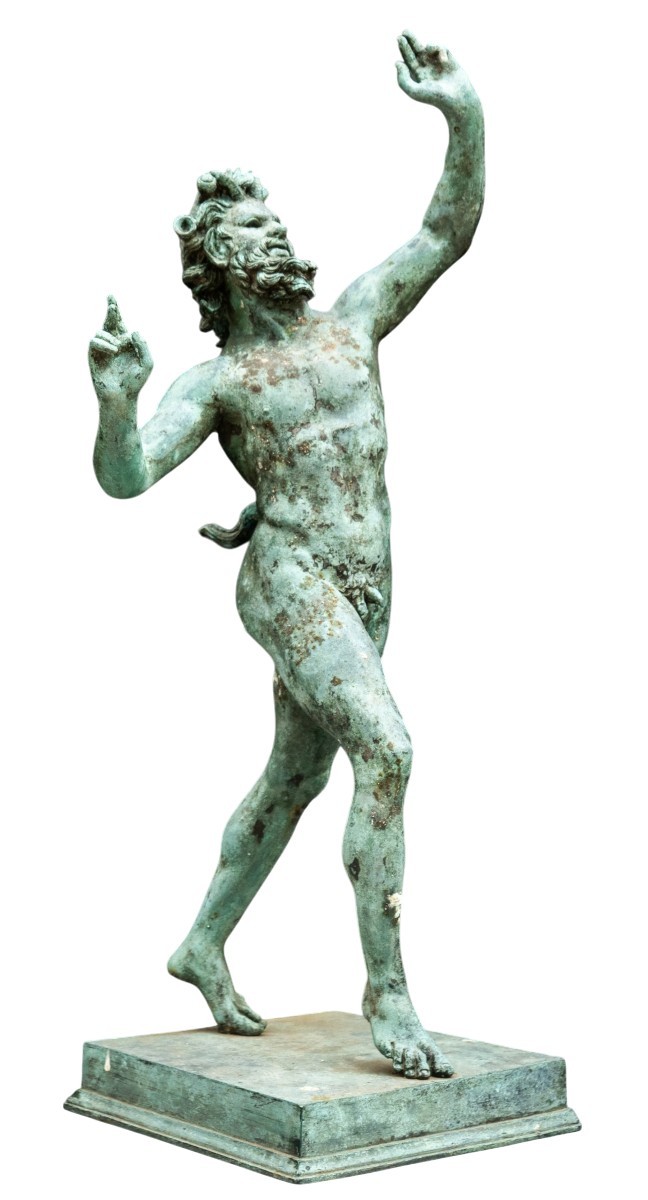
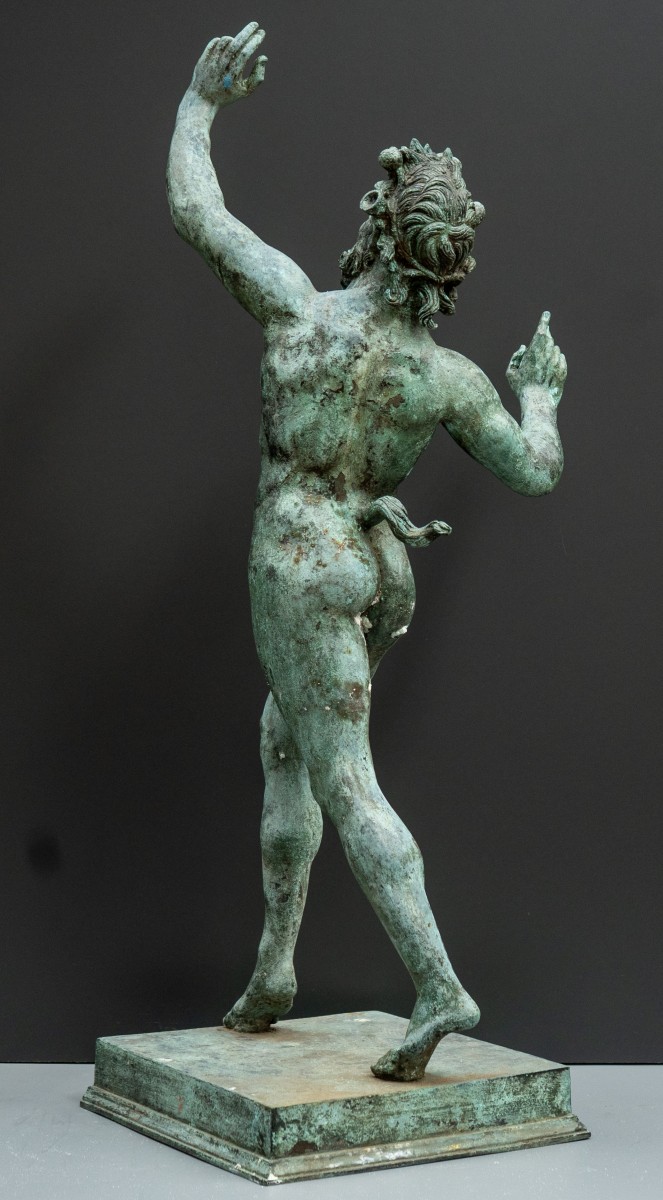
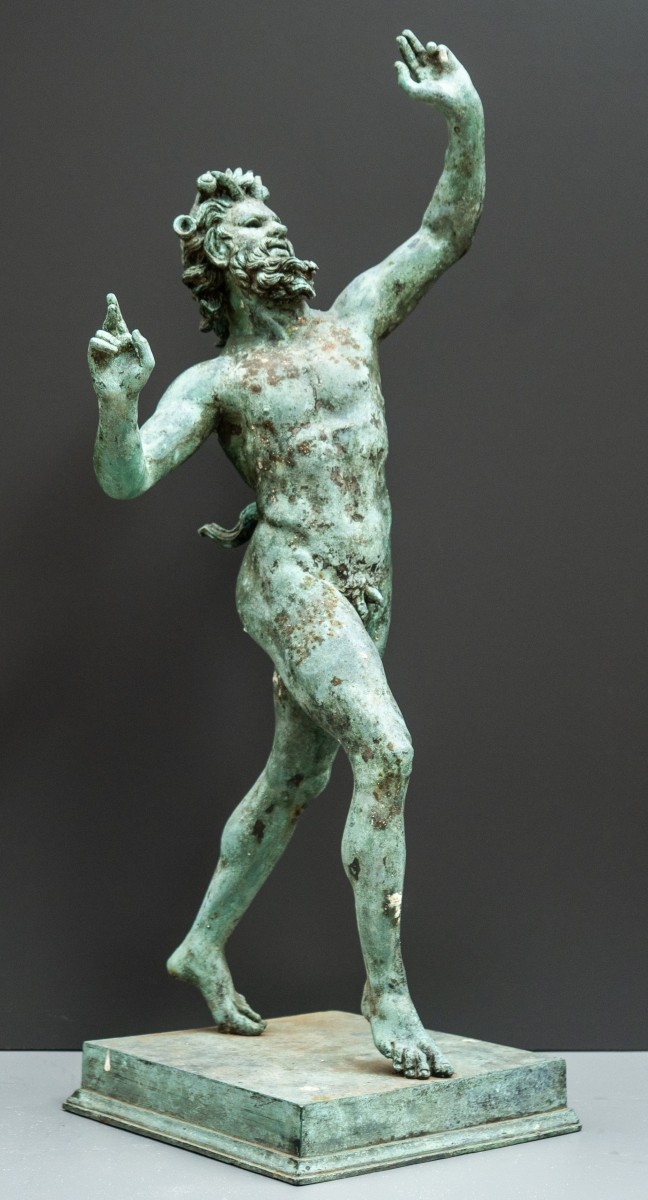
A finely cast patinated bronze reduction of the celebrated Fauno Danzante, after the Roman bronze excavated in 1830 at the Casa del Fauno, Pompeii, and preserved since in the Museo Archeologico Nazionale di Napoli (inv. 5002).
The satyr is shown mid-dance, weight borne on the left leg with the right heel raised, the right arm extended aloft and the left bent with fingers snapping in the gesture of the crotala. The head is turned upward and slightly to the proper left, crowned with tousled curls from which emerge small goat horns, framing pointed ears and a bearded face with open mouth. The short caudal appendage, characteristic of the satyr iconography, is clearly modelled at the base of the spine. Raised on the original stepped square plinth cast integrally with the figure.
The surface bears a deep green oxidised patina imitating the archaeological encrustation of the Pompeian prototype, with warm reddish cuprite tones visible beneath on the torso and thighs, typical of the patine à l'antique applied by the great Neapolitan workshops (Chiurazzi, Sabatino De Angelis, Sommer) who supplied Grand Tour travellers and the international market from the second half of the 19th century onward.
Dimensions: height 80 cm, width 27.5 cm, depth 26.5 cm.
Condition: minor surface losses to the patina consistent with age and handling, structurally sound.
Literature:
F. Haskell and N. Penny, Taste and the Antique. The Lure of Classical Sculpture 1500 to 1900, New Haven and London, 1981.
A. Ruesch (ed.), Guida illustrata del Museo Nazionale di Napoli, Naples, 1908, no. 854.
S. Reinach, Répertoire de la statuaire grecque et romaine, Paris, 1897 to 1930, vol. II, p. 161.
Fonderia Artistica Chiurazzi. Catalogo generale, Naples, editions of circa 1910 and 1929, model listed among the reductions after Pompeian bronzes.
A. Dwyer, Pompeian Domestic Sculpture. A Study of Five Pompeian Houses and their Contents, Rome, 1982.
C. Gasparri (ed.), Le Sculture Farnese, Naples, and related Museo Archeologico Nazionale di Napoli publications on the bronzes from the Vesuvian sites.