Offered by Galerie Nicolas Lenté
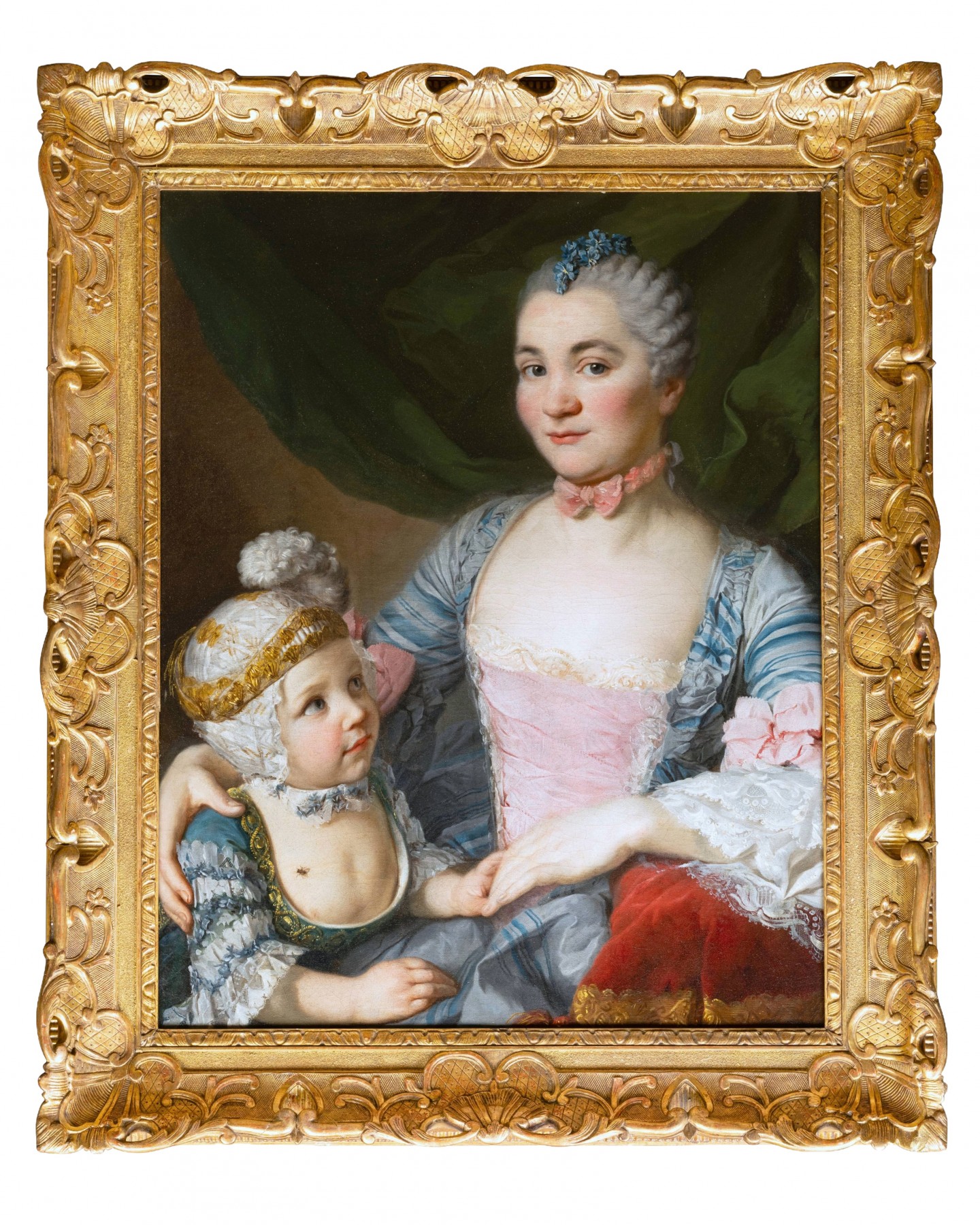

Portrait of a lady with her son,
Workshop of François Hubert Drouais (Paris 1727-1775),
French School, mid-18th century, circa 1760
Oil on canvas: h. 71.5 cm, w. 58.5 cm.
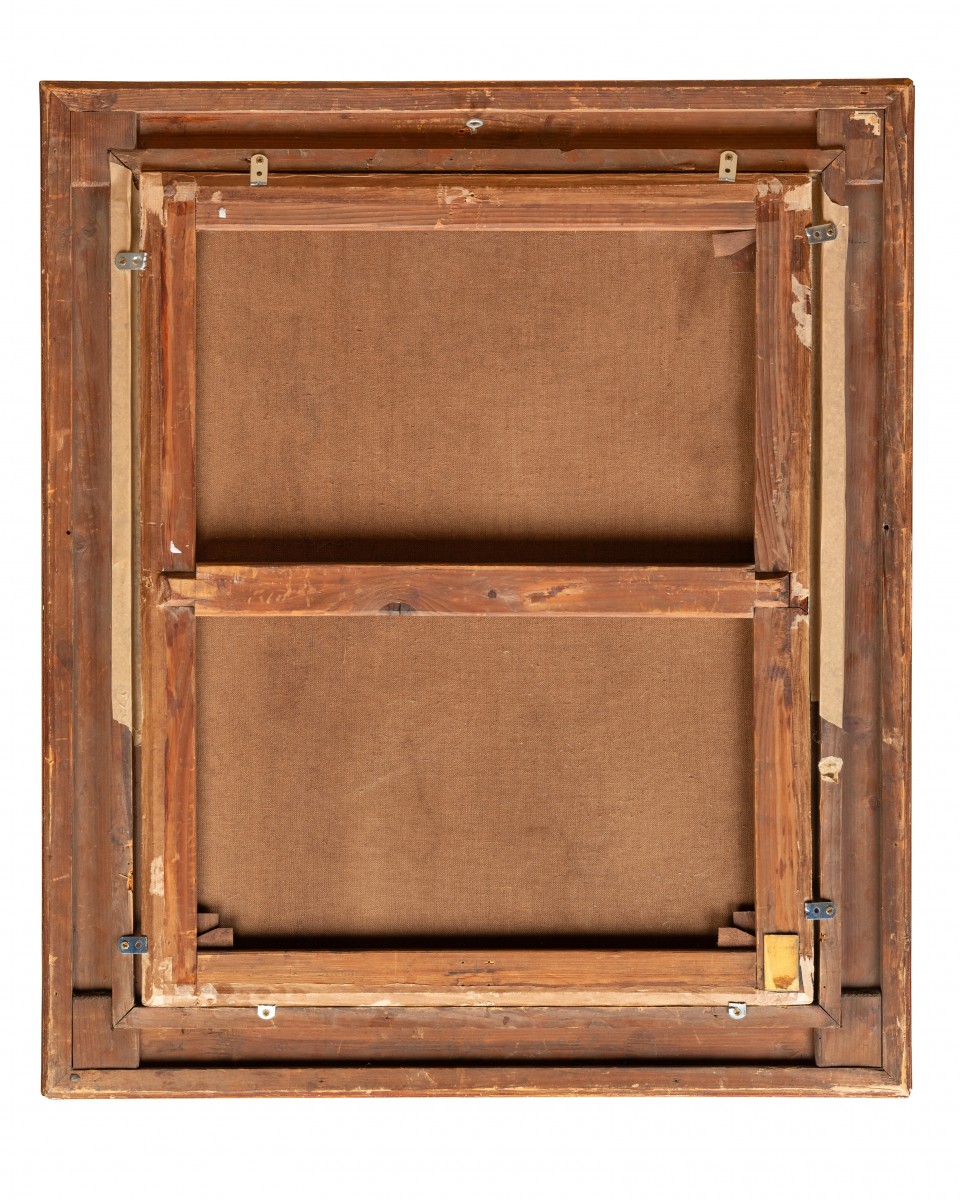
19th-century carved giltwood frame, dimensions: h. 91.5 cm, w. 78.5 cm
Provenance:
Collection of Camille Groult (1832-1908), French industrialist and art collector.
Then by descent, the sale of his collection, Galerie Charpentier, Groult Collection, March 21, 1952, lot 74
The work we are offering is a rare example of a French family portrait from the mid-18th century. Evoking both maternal tenderness and dynastic continuity, the emphasis is placed on the exuberant attire of the two protagonists, intended to display their high social status and highlight the family's wealth.
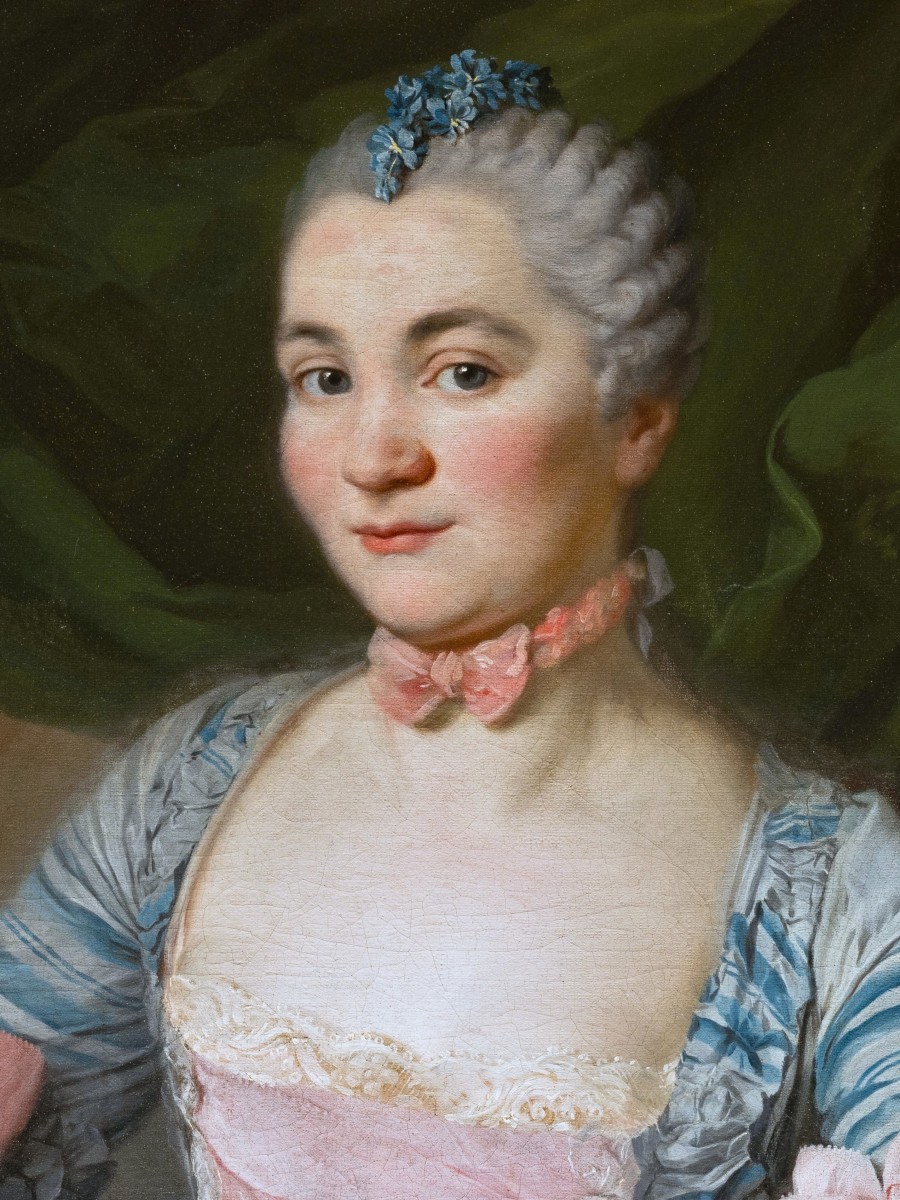
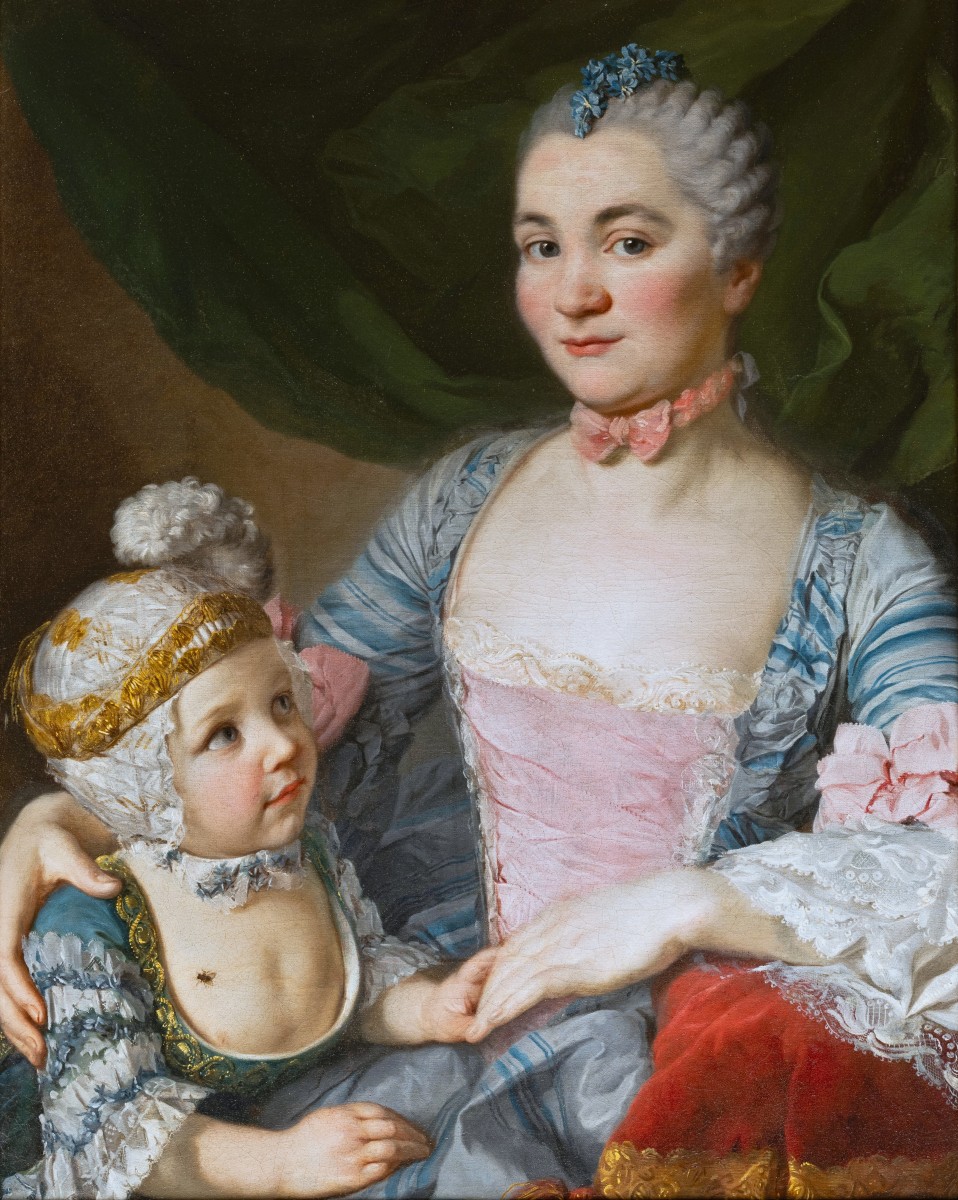
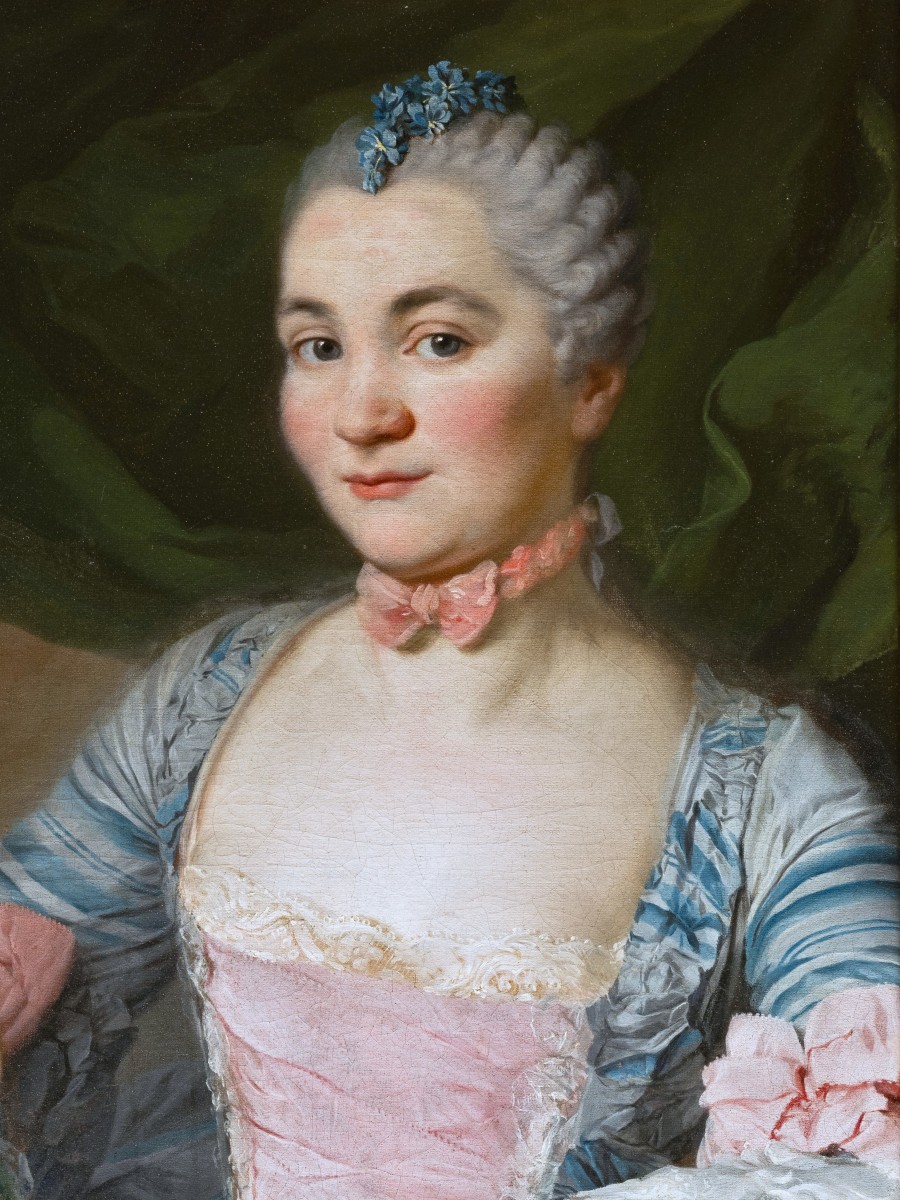
In an intimate setting within a luxurious interior, a young mother sits with her son. Portrayed in a half-length portrait, turned three-quarters, the young woman gazes gracefully at the viewer.
Her son, positioned by the painter to her right, is depicted in a bust portrait, standing with his head restraint on his mother's knees.
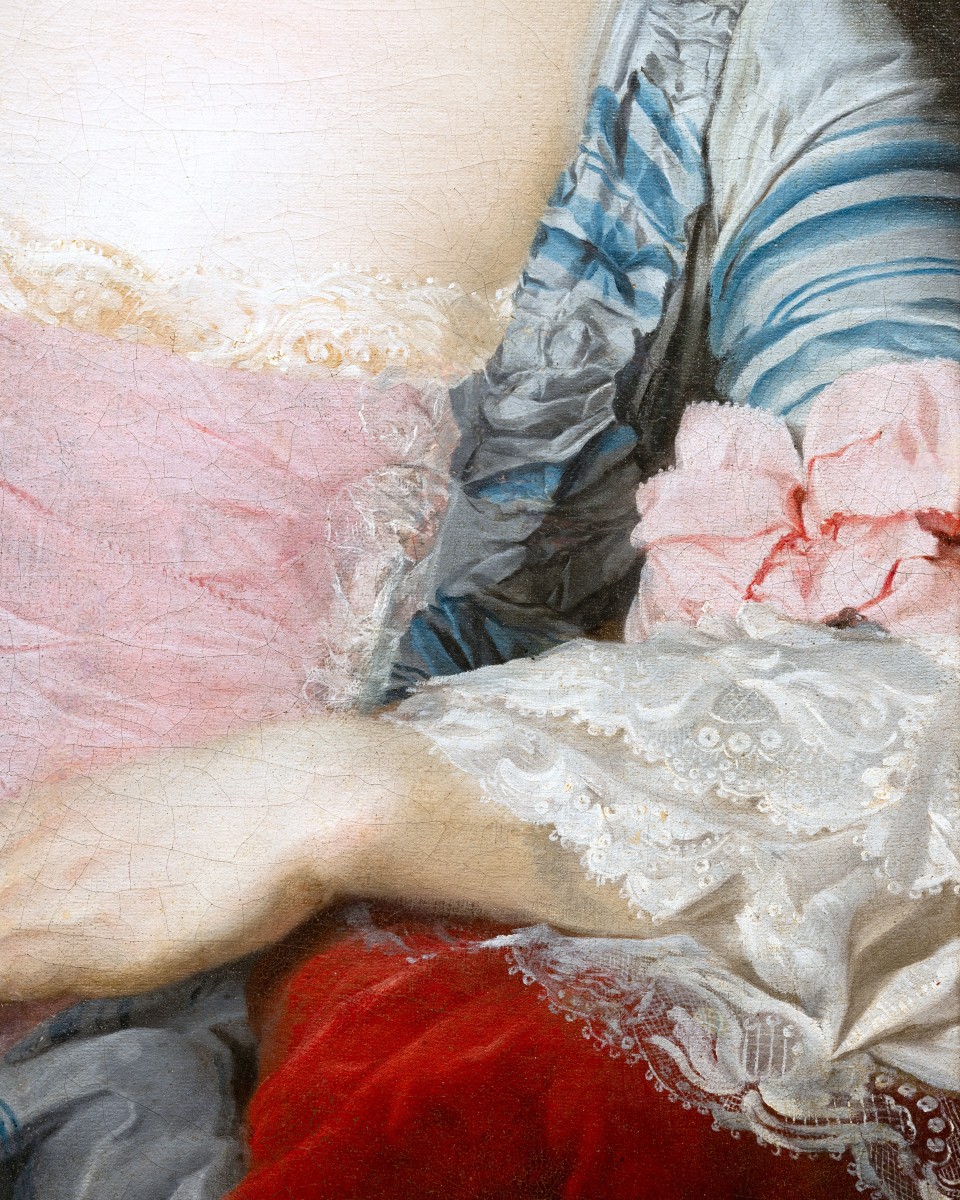
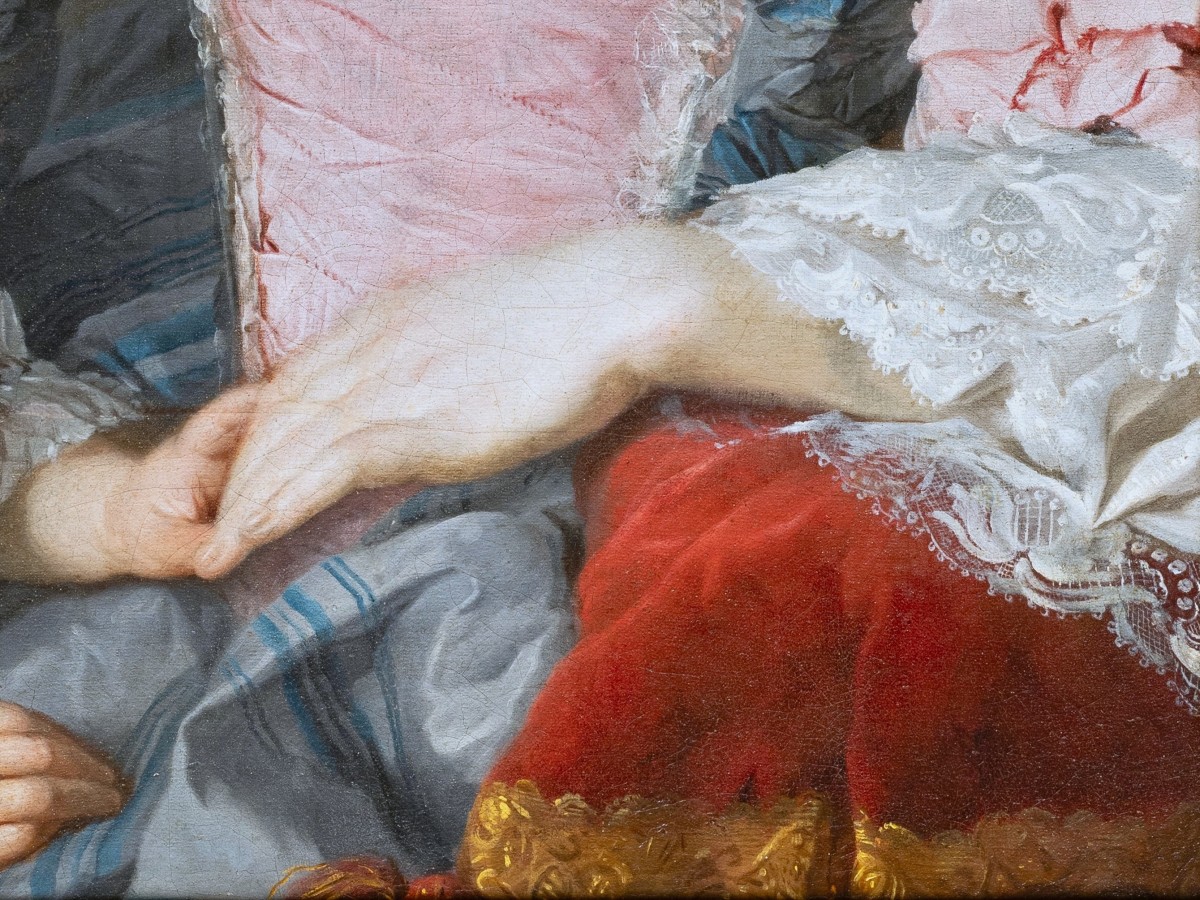
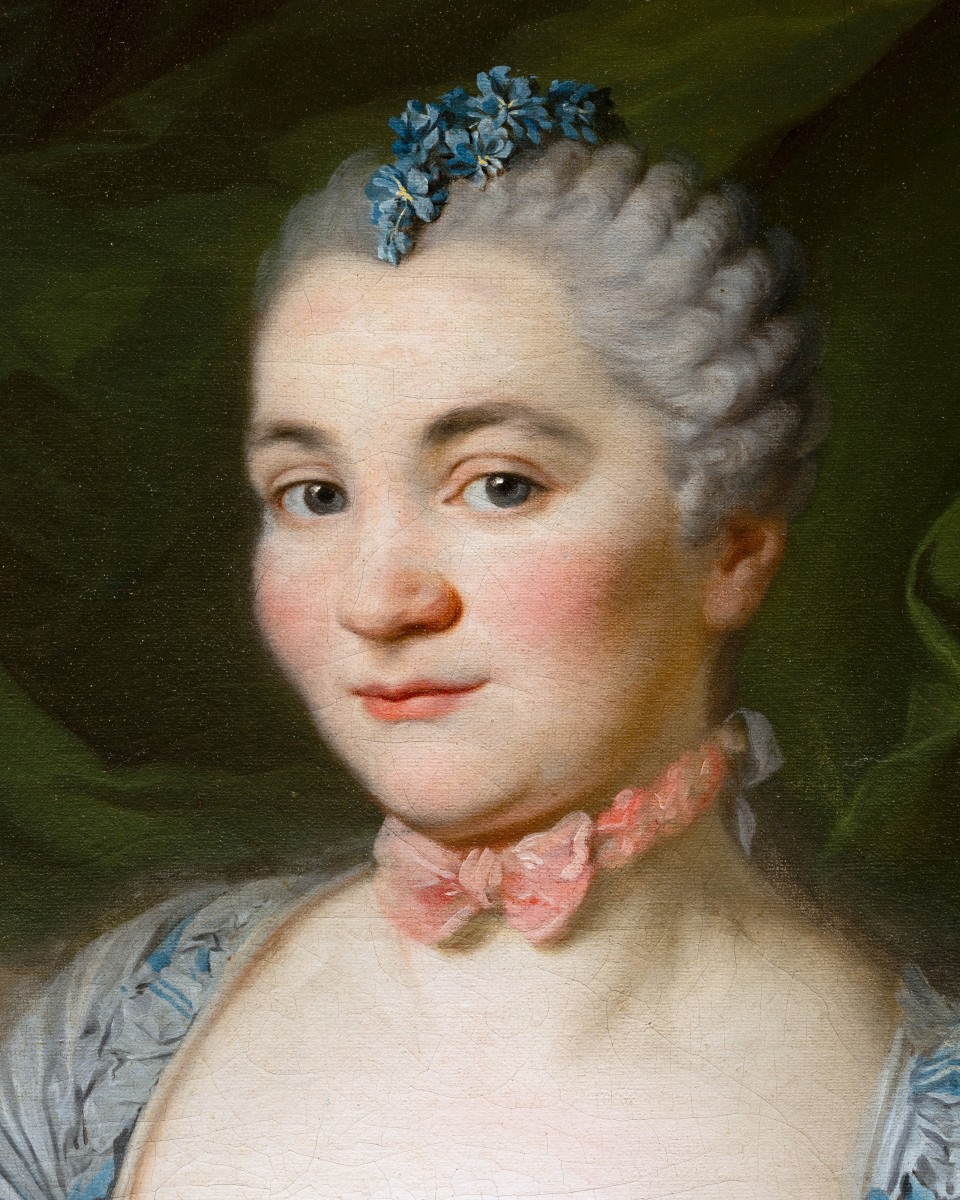
Following the fashion of the time, the young woman wears a blue striped silk gown "à la française" with a wide square neckline adorned with pleated ribbons, and a pink silk corset trimmed with delicate white lace. The sleeves, stopping at the elbow, are adorned with wide pink ribbon bows and overlapping lace ruffles. Around her neck, she wears a pink ribbon tied in the same shade as her corset.
Her hair is powdered and styled in a "sheep's head" cut, very fashionable during the reign of Louis XV, and to emphasize the fresh, spring-like appearance of the garment, a few blue flowers are tucked into the strands at the crown of her head.
The lively gaze of her blue eyes animates her face with its high cheekbones and generously rouged cheeks.
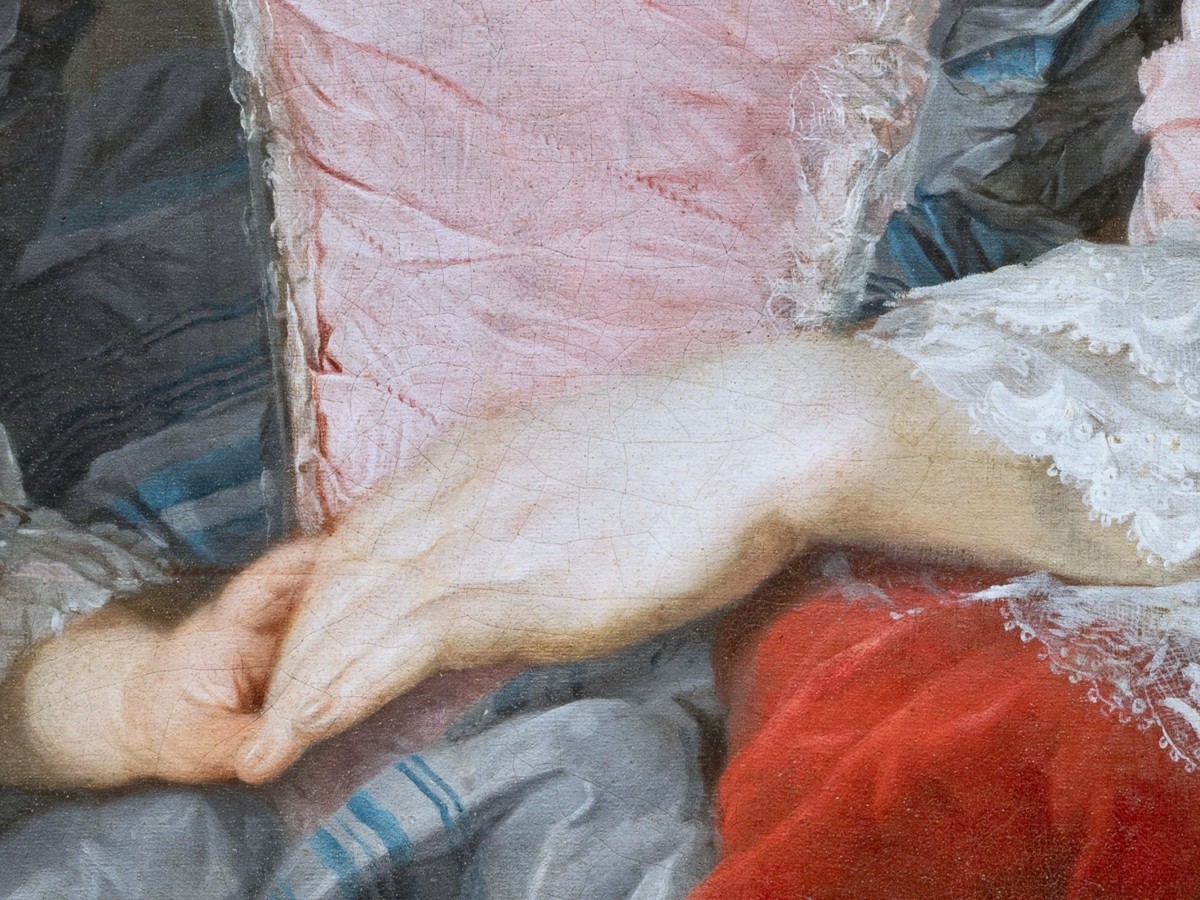
With a protective and benevolent gesture, she places her right hand on her son's shoulder, symbolically signifying her desire to protect him from the dangers of the world, while her left arm, bent at the elbow, rests elegantly on a red velvet cushion trimmed with gold braid.
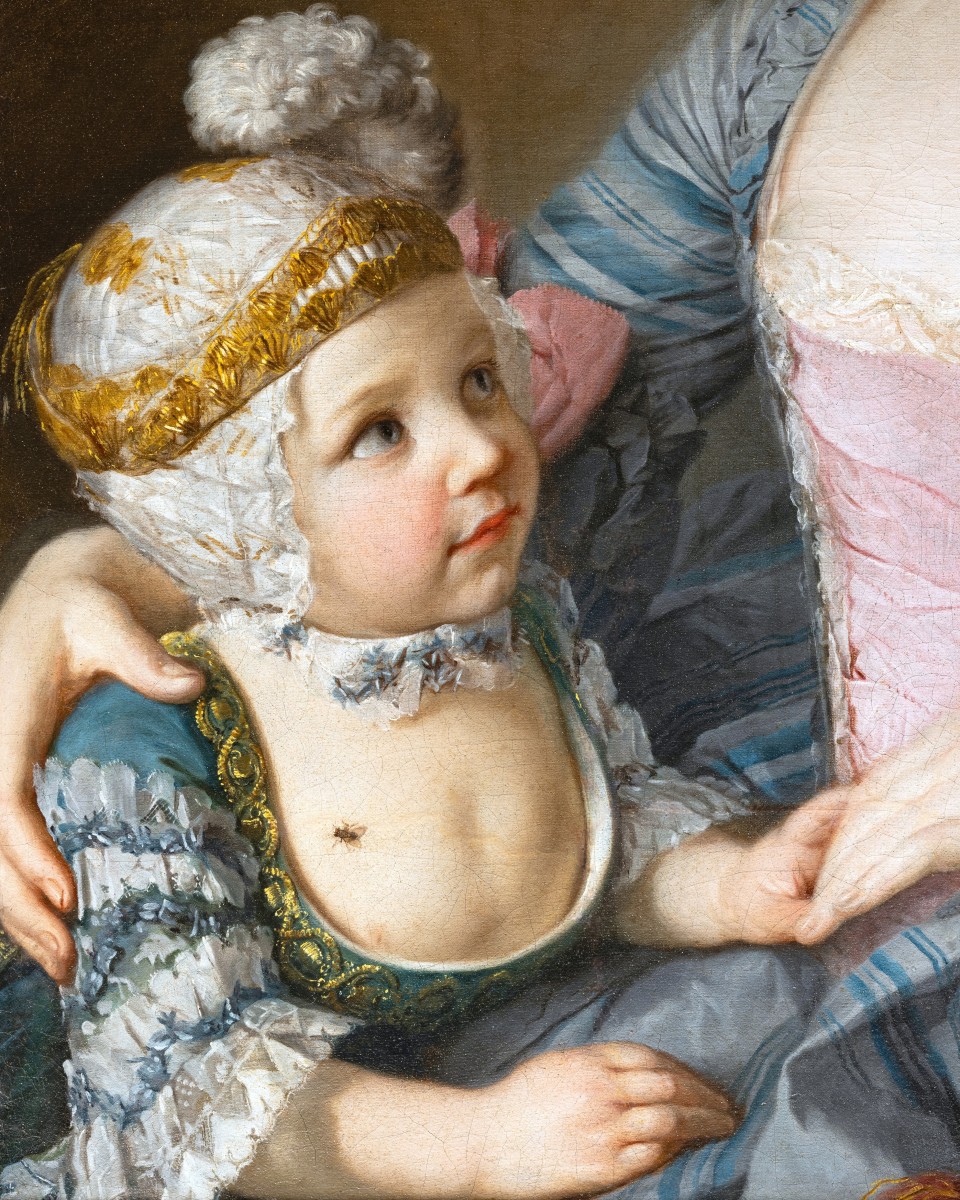
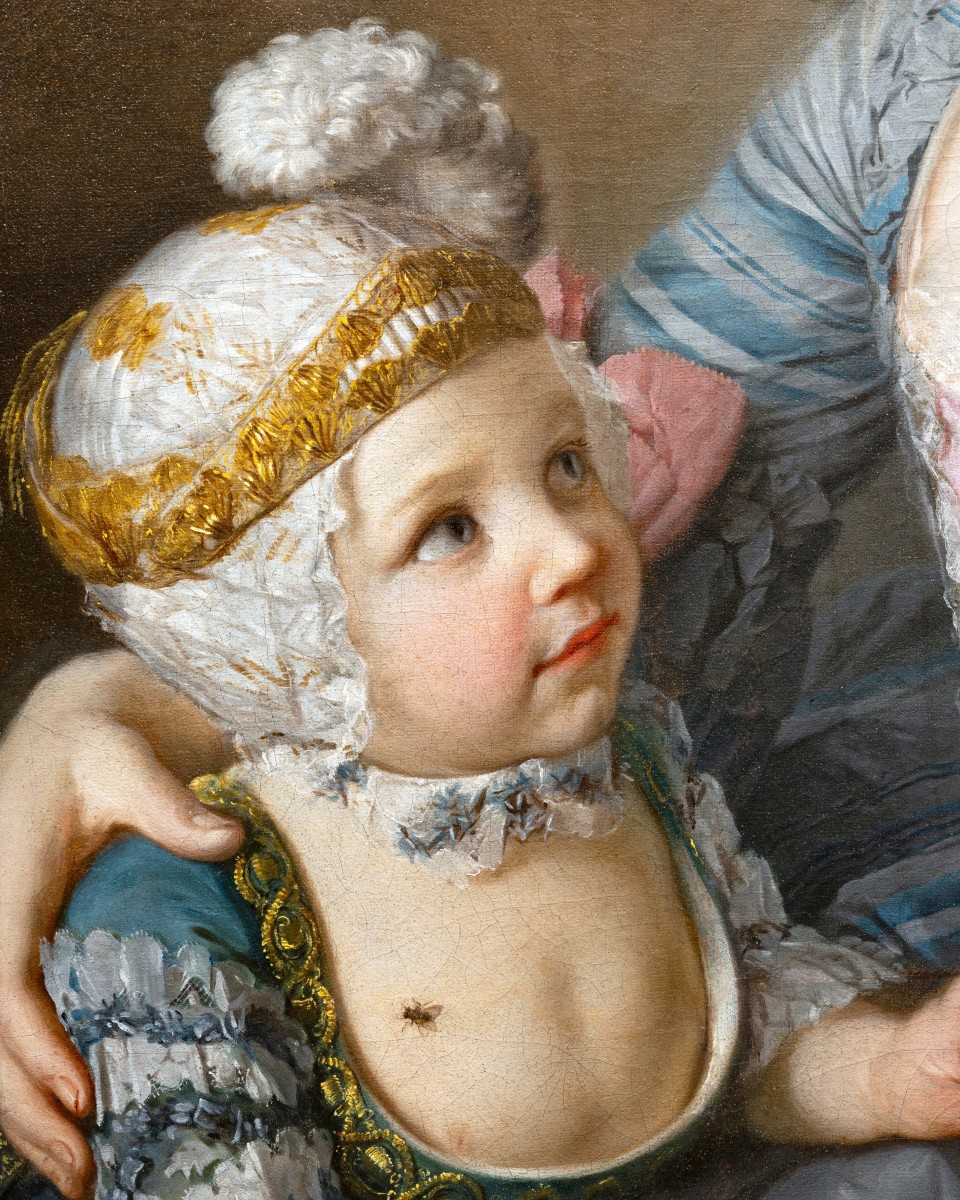
Delicately and timidly, the young boy touches his mother's long, graceful fingers with his small left hand, raises his head, and gazes at her with adoration through his large blue eyes.
Positioned in the foreground, this discreet gesture, full of tenderness and gentleness, is used by the painter to establish an emotional bond between mother and son, despite the mother's apparent restraint, as her gaze is directed towards the viewer.
The subjects' poses offer valuable insight into family relationships under the Ancien Régime, where expressiveness and emotions had to be controlled and conform to the codes of decorum.
The little boy is dressed in a blue silk robe adorned with blue bows and white lace ruffles; the neckline is embroidered with gold thread. Around his neck, he wears a white lace ribbon decorated with small blue bows.
His head is covered with a ceremonial white lace cap, adorned with a wide braid woven from gold thread and surmounted by an ostrich feather, a symbol of luxury and exoticism reserved for the nobility. This also indicates that it is a little boy and not a little girl (since children of both sexes wore dresses until around the age of seven under the Ancien Régime).
The artist introduces a rather curious detail into the portrait: the small fly on the child's chest. Symbolizing the ephemeral nature of life, the insect in this context undoubtedly evokes the extreme fragility of a child's existence.
The refinement of the little boy's clothing, dressed like a miniature adult, indicates his high social standing. In aristocratic circles, the child is the very image of his family, embodying the continuity of the lineage and expected to reflect the family's prestige through his attire.
From a stylistic point of view, the subtle treatment of flesh tones, the attention paid to the rendering of fabrics and lace, and the meticulous and well-constructed composition suggest a Parisian artist from the immediate circle of François Hubert Drouais. The pursuit of a psychological dimension and his specialization in portraits of children lead us to believe that the work was painted in his studio by a student or workshop assistant.
François-Hubert Drouais , known as Drouais the Younger (born December 14, 1727, in Paris, where he died October 21, 1775), was a French painter specializing in portraits, a genre he dominated at the end of Louis XV's reign.
He studied successively under his father, Hubert Drouais, Donat Nonnotte, Carle Van Loo, Charles-Joseph Natoire, and François Boucher. Admitted to the Royal Academy on November 25, 1758, upon presentation of a portrait of Coustou and a portrait of Bouchardon (now in the Louvre) as his reception piece, he was quickly summoned to Versailles.
He became one of Madame de Pompadour's favorite painters, and a famous portrait of her, painted in 1763–1764, is now in the National Gallery, London. He later worked for Madame du Barry. He quickly gained considerable renown at court, executing portraits of the royal family and nobility (such as the Portrait of Madame de Tencin), artists (like Edme Bouchardon, sculptor, Paris, Carnavalet Museum), full-length or bust-length, and also portraying distinguished visitors invited to Versailles. Showing little concern for capturing the psychological truth of his subjects, he readily indulged in flattery, considerably idealizing his models, while simultaneously incorporating an originality into court portraiture that set him apart from "the baroque grandeur of Rigaud and the allegorical mythologies of Nattier."
He distinguished himself in portraits of children, of which The Count of Artois and his sister, Madame Clotilde[1], is the most moving example, but one might also mention The Children of the Duke of Bouillon disguised as little Savoyards, The Duke of Berry and the Count of Provence in their childhood, Alexandrine Lenormant d'Etioles, and Little Girl Holding Her Doll. He also revived the tradition of family portraits (for example, The Family of the Marquis de Sourches, 1756, exhibited at the Salon of 1759, now in Versailles), placing his subjects in a subtle and realistic setting, in contrast to the theatricality of François Boucher, and thus foreshadowing the sensitive portraits of Elisabeth Vigée-Lebrun. The idealization of the sitter sometimes leads to a certain superficiality and inexpressiveness, combined with the porcelain tones of the somewhat artificial and exaggeratedly made-up flesh, which here links him to the generation of Nattier. However, Diderot recognized in him a "pleasant invention," and Drouais demonstrates a talent for staging anecdotal details, pets, and accessories that reveal a certain skill for still life, establishing him as the dominant figure in portraiture at the end of Louis XV's reign.
Delevery information :
We organize the shipping and delivery of our artworks worldwide, working with specialized fine art carriers as well as DHL Express for the secure shipment of small and medium-sized works (up to 120 cm).
Each artwork is carefully packed and shipped in a custom-made transport crate to ensure optimal protection. All shipments are fully tracked and insured.
We pay the utmost attention to every stage of the shipping process to ensure fast, reliable delivery. Shipments via DHL Express are generally dispatched within approximately 7 days of purchase.
All of our artworks can be viewed at our Paris gallery and may also be collected in person.