Offered by Costermans Antiquités
REQUEST INFORMATION

Old Masters paintings, 16th, 17th and 18th furnitures and works of art
Elias VAN DEN BROECK (Amsterdam, c. 1649 — 1708)
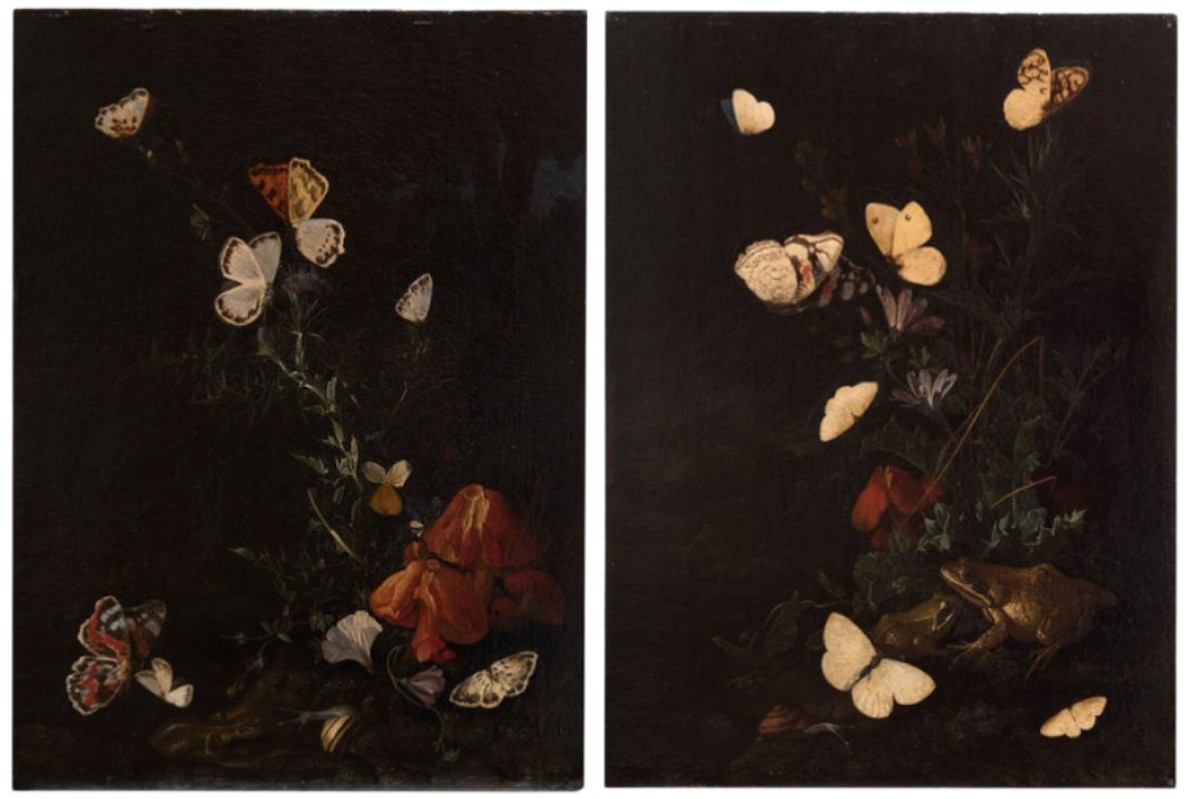
Pair of Sottoboschi
c. 1680-1690
Oil on panel, 29 x 21.5 cm
This pair of vertical paintings, rendered against a dark, deep, almost nocturnal background, highlights the natural elements depicted through a striking contrast of light.
Both compositions depict scenes of undergrowth, where botanical and entomological elements are arranged in a confined space, with no horizon or identifiable landscape. The vegetation consists of low plants, leafy stems, wild flowers and mushrooms, rendered with precise attention to texture and detail.
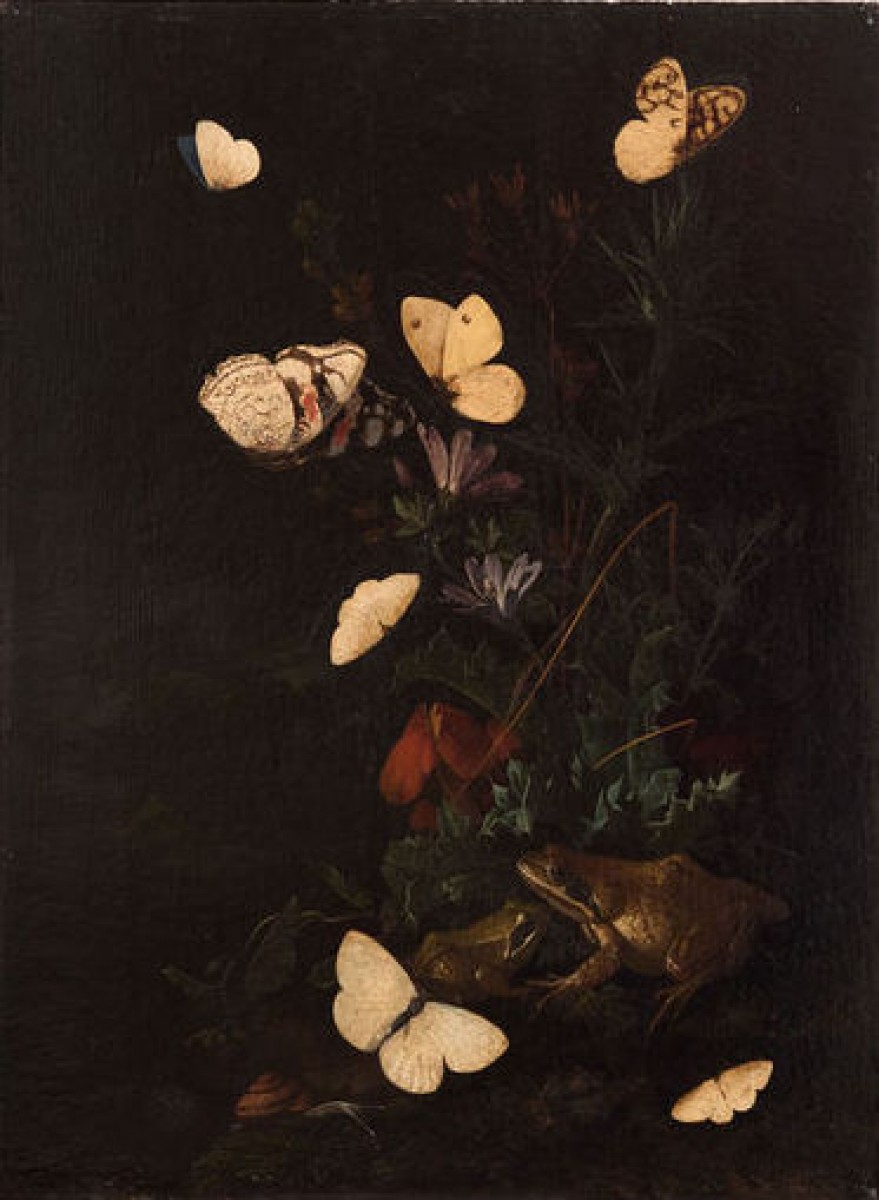
Butterflies occupy a central place in both works. They are depicted in flight or perched at different heights in the composition, their wings spread showing colour variations ranging from creamy white to pale yellow, orange and brown, sometimes punctuated with darker patterns. Their arrangement creates an effect of vertical dispersion and visually animates the space.
In the lower part of one of the paintings, a frog appears, perched on dark, damp ground, accompanied by small creatures such as a snail and a caterpillar. These creatures are integrated into the ground and vegetation, reinforcing the impression of a dense, enclosed natural environment.
The flowers, modest in size, have simple white, yellow or orange corollas and are rendered with soft contours and smooth texture. The foliage is painted in a range of muted greens, sometimes bluish, with targeted touches of light.
Elias van den Broeck studied painting in Amsterdam under Cornelis Kick in 1665 and under Jan Davidsz de Heem in 1669 in Utrecht. He accompanied the latter to Antwerp in 1673 and became a member of the Guild of Saint Luke.
His work focused mainly on floral still lifes and undergrowth scenes (sottobosco). It responded to a sustained demand for refined bouquet compositions and extremely detailed naturalistic subjects, including insects, reptiles, mosses and fungi, often depicted as subjects for close observation.
Elias van den Broeck's style is distinguished by his rigorous and meticulous observation. His bouquets are structured, with firm stems and detailed foliage. His undergrowth compositions highlight micro-fauna and flora, with remarkable realism in the rendering of textures and species. Van den Broeck's work is distinguished by his pronounced use of strong contrasts between light and shadow, which give his compositions depth and visual intensity.
The pair of paintings can be attributed to van den Broeck's Amsterdam period, when he was more interested in naturalistic representations of undergrowth. Fred Meijer suggests dating them to 1680-1690.
It is fascinating to note that this pair of paintings was created using real butterfly wings, meticulously glued onto the panel. Although the fragility of the materials and restorations have likely led to their disappearance, this unique feature remains an exceptional testament to the artist's inventiveness, giving these works a rare and valuable uniqueness on the art market.