Offered by Galerie Lamy Chabolle

REQUEST INFORMATION

Decorative art from 18th to 20th century
Marble.
Italy.
1780-1790.
29 x 59 x 24 cm (11.4 x 23.2 x 9.4 in).
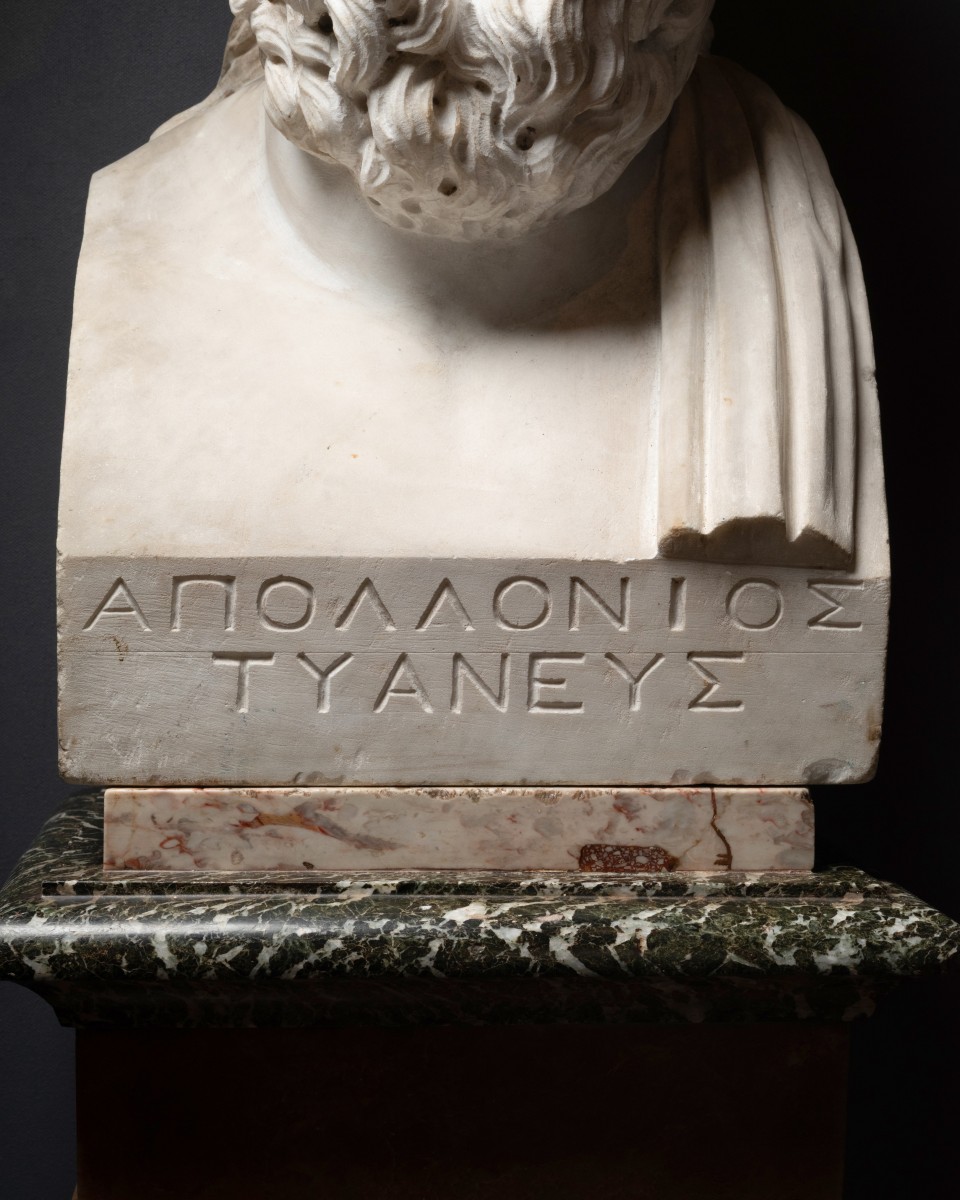
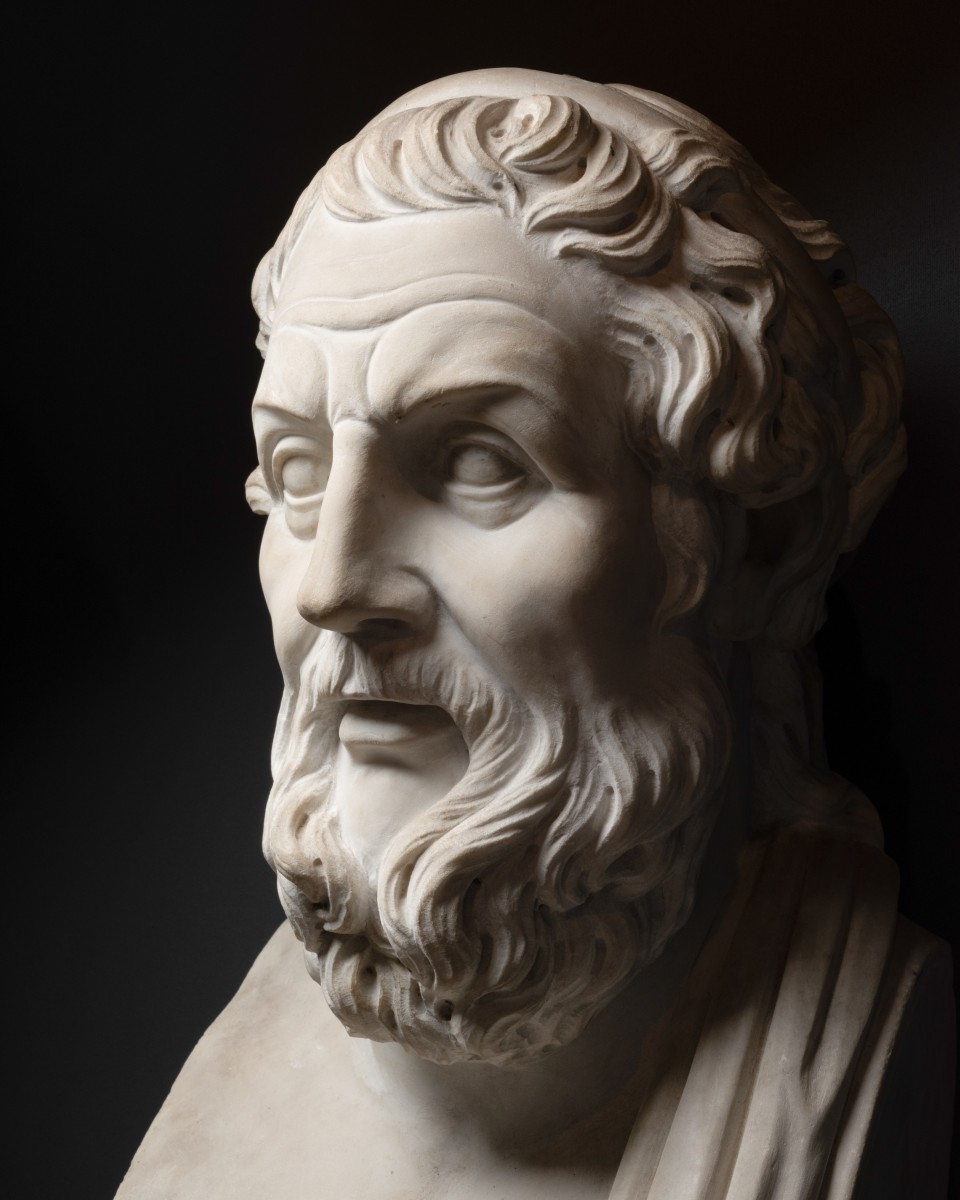
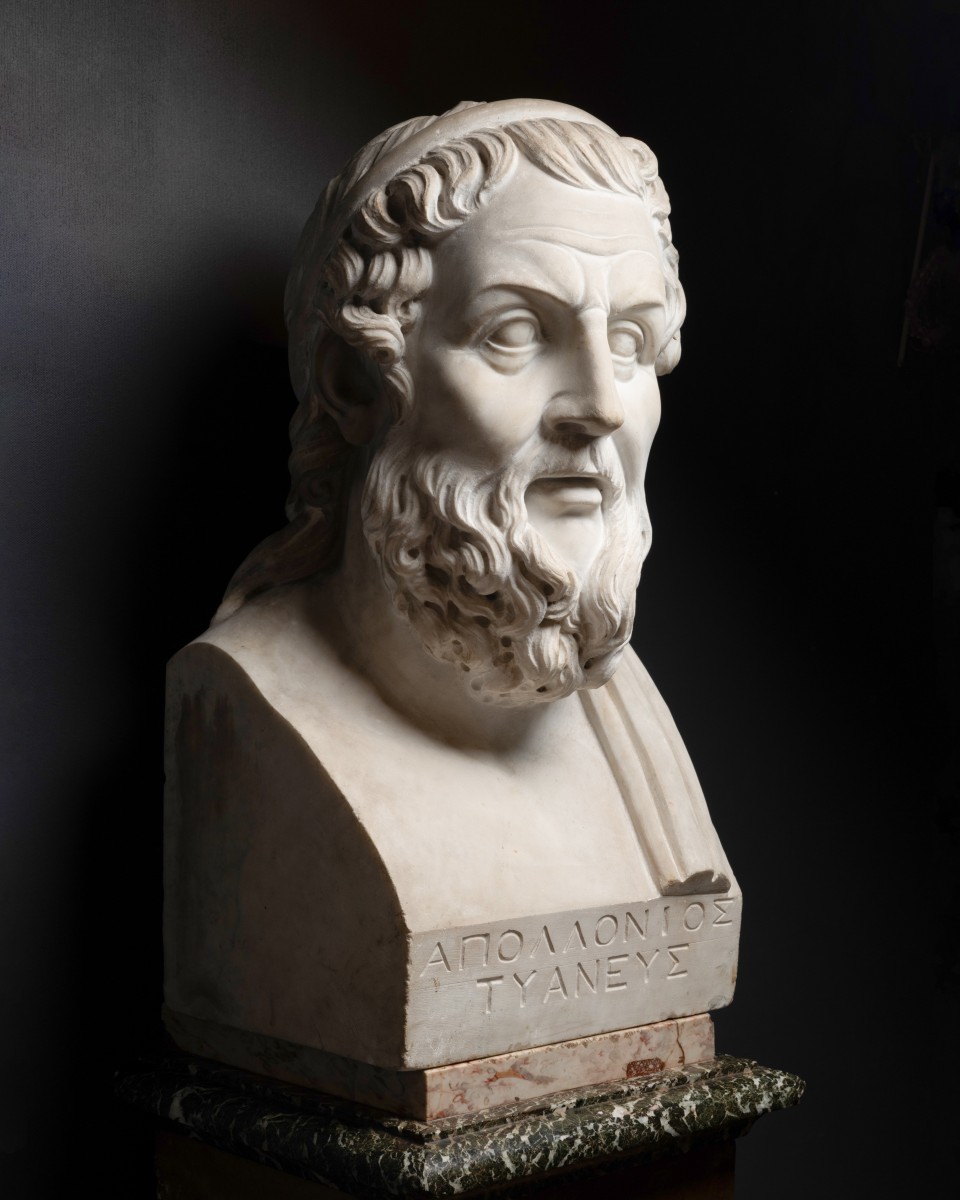
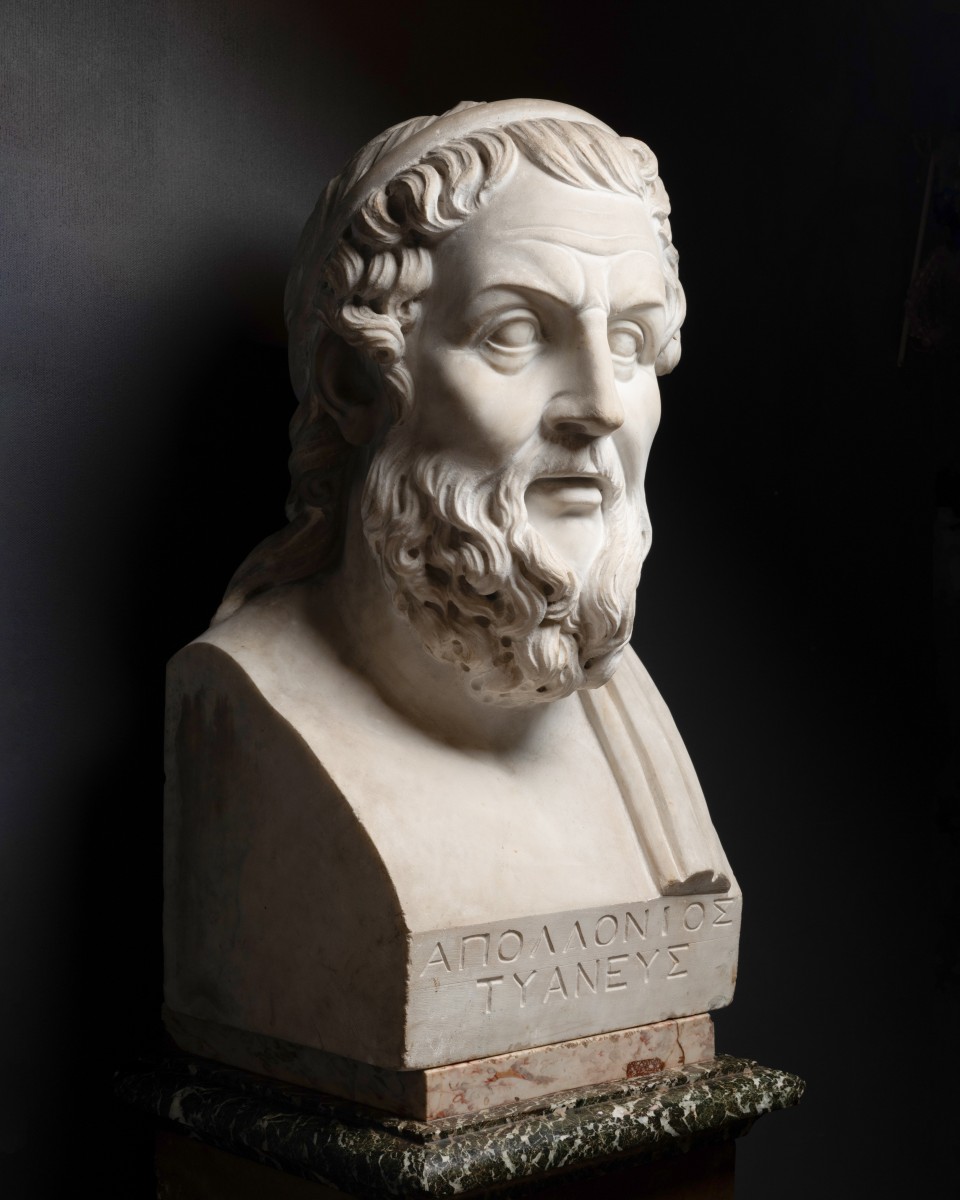
his bust, carved from white Carrara marble, depicts the bearded face of an elderly man, his head turned slightly to the right. He wears a thick rolled headband, or taenia, crowning an abundant head of hair that falls onto the nape of the neck. The eyes are large and deeply set but not incised, conveying the vacant gaze associated with blindness. The bust terminates in the form of a herm and features a Greek inscription on the chest. The technical virtuosity of the execution lies in its rigorous fidelity to the Severe style of the antique prototype. The precision of the proportions suggests the use of a pointing machine, or compasso, allowing for a near-perfect imitation of the ancient model held in the Stanza dei Filosofi of the Capitoline Museums.
For much of the 17th and 18th centuries, this type of portrait was identified as Apollonius of Tyana, a Neo-Pythagorean ascetic born in Cappadocia at the beginning of the Christian era. In a brief, eloquent, yet stern account of his life, the archaeologist Ennio Quirino Visconti wrote that Apollonius : “affected in truth a great severity of morals and led a hard and ascetic life […], traveled through the various provinces of the Roman Empire, and even other countries so that everyone might admire his virtues; and he was particularly committed to restoring the rites of pagan worship. He went twice to Rome, where it is said he endured some persecutions; and after making his most common residence in several cities of Asia, particularly Smyrna and Ephesus, he concealed his final moments, being over ninety years old, from the knowledge of his disciples, likely so that his death would have the appearance of an apotheosis. […] A certain Hierocles dared, two centuries later, to oppose this hero of paganism to the divine legislator of the Christians. This act of impudence prompted Eusebius, Bishop of Caesarea, to write a refutation of Hierocles, which proves—by the considerations he feels obliged to maintain for the person of Apollonius—to what extent the memory of the Pythagorean was venerated in the world.”
The identification of this type of portrait as Apollonius dates back to the mid-17th century and Leonardo Agostini, superintendent of antiquities in Rome under Alexander VII. Agostini had drawn a parallel between the features of a bust of this type and a profile appearing both on a contorniate medallion and on one of the gems in the Fulvio Orsini collection. Ennio Quirino Visconti definitively corrected this attribution in the early 19th century based on numismatic evidence from Amastris, reclassifying portraits of this type as one of the four primary Hellenistic portraits of Homer.
As for the present bust, an imitation after the Capitoline bust, it must be attributed to Carlo Albacini and his workshop. Albacini lived from 1756 to 1759 alongside Bartolomeo Cavaceppi in the artists' quarter of Rome. He appears to have remained in his master's immediate circle during the peak of Cavaceppi's career, from the 1760s to the early 1770s. At this time, Albacini began undertaking restorations for English clients and dealers who were also patrons of Cavaceppi, notably Charles Townley and William Blundell, as well as the Earl of Lansdowne, Thomas Mansel-Talbot and James Smith Barry.Albacini’s reputation as a sculptor and restorer was then second only to that of Cavaceppi, restorer to Popes Benedict XIV and Clement XIII and supervisor of some of the most significant restorations of the marbles in the Museo Pio-Clementino. It is unsure whether Albacini himself performed restoration work on the Capitoline Homer-Apollonius herm that served as the model for this bust. However, an inventory of plaster casts sold by Albacini’s son, Filippo, in 1838, mentions three copies of "Apollonius of Tyana." One of these is a replica of a herm of the same type, formerly in the collection of José Nicolás de Azara, the Spanish ambassador to Rome, and now held in the Prado.
The most compelling evidence regarding the context of the bust’s execution lies in the Greek inscription visible on the portrait. The name Apollonius derives from Apollo, which in Ancient Greek requires an unaccented omicron in the first syllable and an accented omega in the second. The sculptor of this bust made the error of writing the second "o" of Apollonius with an omicron instead of an omega. Remarkably, a similar error is found on another bust reputed to represent Apollonius of Tyana — a once famous, now-lost bust that belonged to Giuseppe Valletta before passing to the Earls of Pembroke at Wilton House.Regarding Albacini, it is known that he and his assistants were accustomed to adding the names of the presumed subjects to the busts, both on restored works and on replicas : “The base was also generally provided with an inscription in Greek letters, giving the supposed identity of the subject. It is only in very few cases that modern scholarship would agree with these identifications (e.g. ‘Carneades’ and ‘Periander’ are probably correct identifications, but ‘Herodotus’ is in fact Aristogeiton, and ‘Pittacus’ may represent Miltiades), and several are portraits of anonymous Greeks, confidently (but without justification) identified by the modern inscription as, for example, Theocritus, Heraclitus, Theophrastus, and Heracles.”
The presence of this spelling error suggests a common iconographic or philological source shared by the restorer of the Wilton House bust and the sculptor of the present work. It links these two pieces not by form—since one indeed represents Apollonius while the other actually depicts Homer—but by the shared intellectual climate of their creation. Both testify to the pre-scientific enthusiasm for ancient marbles that characterized the history of early modern European collecting, a period when the eagerness to possess antiquities, or failing that, their imitations, often outweighed archaeological rigor.Given the rarity of the Apollonius type, it is highly improbable that such an error in identification and inscription would have been committed after Visconti overturned Agostini’s thesis. This places the bust in the earliest phase of modern "anticomanie," specifically in the 1780s—the period when the marbles of the Azara collections were being restored by Albacini.